
- India
- Jan 23
India celebrates ‘Parakram Diwas’ on Jan 23
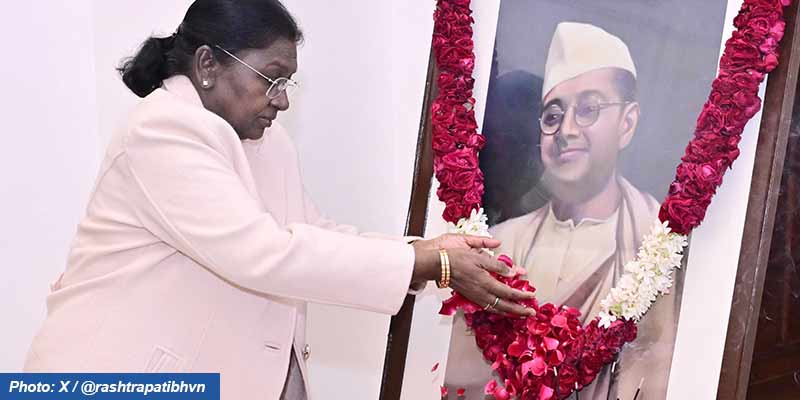
• President Droupadi Murmu paid floral tributes to Netaji Subhas Chandra Bose on his birth anniversary at Rashtrapati Bhavan on January 23.
• The government celebrates the birth anniversary of Subhas Chandra Bose as ‘Parakram Diwas’.
Who was Subhas Chandra Bose?
• Subhas Chandra Bose, popularly known as Netaji, was an outstanding leader of the Indian freedom movement.
• He effectively took the Indian freedom movement beyond the frontiers of India, which is perhaps a rare feat in the history of our freedom struggle.
• His inspiring words ‘Jai Hind’ have become the national rallying call.
• Bose was born on January 23, 1897 at Cuttack in Odisha.
• In 1920, Bose took the Indian Civil Service examination and secured fourth rank. He, however, resigned from the Indian Civil Service in April 1921 and plunged himself into the national struggle.
• He met Deshbandhu Chittaranjan Das in Calcutta. Deshbandhu welcomed his new youthful lieutenant with open arms and entrusted him with a number of responsibilities.
• In 1924, Deshbandhu was elected as the first Mayor of Calcutta Corporation and Subhas Chandra Bose was appointed the Chief Executive Officer.
• On October 25, 1924, Bose was arrested and sent to Rangoon.
• In Lahore Congress in 1929, Bose moved a resolution that the Congress should aim at setting up a parallel government in the country. The resolution moved by him was, however, defeated.
• He was elected as the president of the INC in 1938 and 1939 but resigned due to differences with Mahatma Gandhi and other leaders over their non-violent approach.
• Bose’s vision for India’s freedom was to leverage the support of Axis powers during World War II.
• He escaped from house arrest in India in 1941, travelling through Afghanistan to Germany, where he sought support from Adolf Hitler.
• On July 4, 1943, he took over the leadership of the Indian Independence Movement from Rash Behari Bose in East Asia.
• He organised the Azad Hind Fauj with its headquarters at Singapore and became its Supreme Commander.
• On October 21, 1943, he proclaimed the formation of provisional government of Azad Hind at a historic assembly in Singapore.
• The provisional government was recognised by nine countries including the then three world powers — Japan, Germany and Italy.
• The INA headquarters was shifted to Rangoon in January 1944. Bose motivated the Indian National Army (INA) with his famous call “Give me blood and I shall give you freedom”.
• The INA reached the Arakan front on February 4, 1944 and marched towards their motherland with the clarion call of “Chalo Delhi” on their lips.
• The Azad Hind Fauj crossed the Burma border on March 18 and for the first time, stood on the soil of India.
• The liberation forces were halted within three miles of Imphal and as they lacked air cover, they were unable to go further into the Assamese territory. • The British forces, under Lord Mountbatten, reinforced by air, were able to successfully stop the Azad Hind Fauj’s march.
• After the suspension of INA activities, Bose went back to Singapore and issued instructions to the civilian and army wings of the provisional government of Azad Hind as to what they should do.
• Bose’s efforts significantly impacted the Indian independence movement, inspiring many with his bravery and dedication.
• Bose’s mysterious death in a plane crash in Taiwan August 18, 1945 has been the subject of much speculation and controversy. Despite various investigations, the exact circumstances of his death remain unresolved.