
- India
- Jan 27
India, EU conclude landmark Free Trade Agreement (FTA)
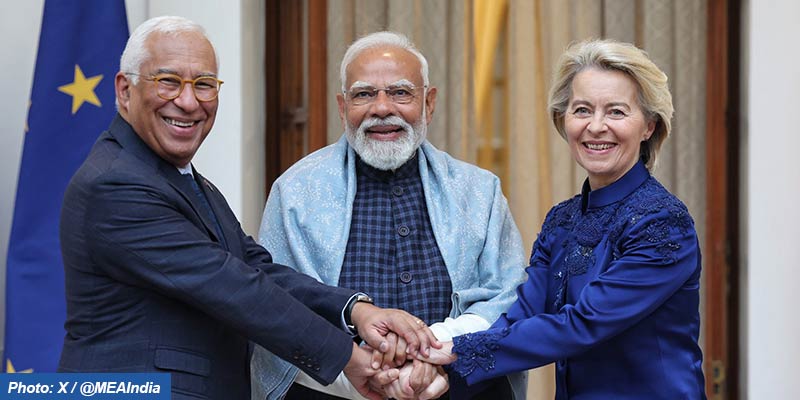
• Prime Minister Narendra Modi and European Commission President Ursula von der Leyen jointly announced the conclusion of the India-European Union Free Trade Agreement (India–EU FTA) at the 16th India-EU Summit in New Delhi on January 27.
• PM Modi hosted von der Leyen and European Council President Antonio Costa at the summit.
• This announcement marks a historic milestone in India-EU economic relations and trade engagement with key global partners.
Why is the India-EU FTA called “mother of all deals”?
• India and EU are fourth and second largest economies respectively, comprising 25 per cent of global GDP and account for one-third of global trade.
• Integration of the two large diverse and complementary economies will create unprecedented trade and investment opportunities.
• The agreement is dubbed as “mother of all deals”, that came against the backdrop of a fractious global environment and trade disruptions largely caused by Washington’s policy on tariff.
• The EU becomes India’s 22nd FTA partner.
• In the past decade, the Indian government has signed trade deals with Mauritius, UAE, UK, the European Free Trade Association (EFTA), Oman and Australia.
• In 2025, India signed trade deal with Oman and the UK and announced the conclusion of trade deal with New Zealand.
• The India-EU trade deal, along with India’s FTA with the UK and the EFTA effectively opens up the entire European market for Indian businesses, exporters and entrepreneurs.
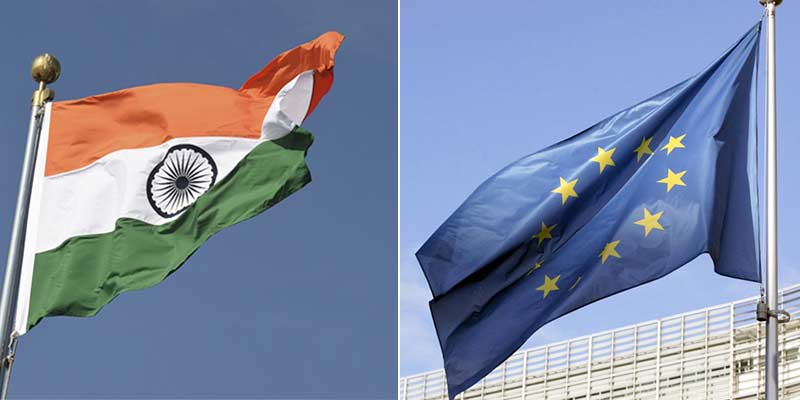
India-EU trade relations
• The European Union is India’s second-largest trading partner after China, with bilateral trade in goods and services growing steadily over the years.
• In 2024-25, India’s bilateral trade in goods with the EU stood at Rs 11.5 lakh crore ($136.54 billion).
• India-EU trade in services reached Rs 7.2 lakh crore ($83.10 billion) in 2024.
• The EU’s imports from India comprise mainly machinery and appliances, chemicals, base metals, mineral products, and textiles.
• The EU's main exports to India consist of machinery and appliances, transport equipment, and chemicals.
India-EU FTA talks
• Negotiations aimed at establishing a Free Trade Agreement (FTA) between India and the European Union (EU) were initiated in 2007.
• After 15 rounds of negotiations in Brussels and New Delhi, the talks between the parties stalled by 2013 and remained in limbo until 2022.
• On June 17, 2022, Indian Commerce Minister Piush Goyal and European Commission Executive Vice-President Valdis Dombrovskis formally relaunched EU-India negotiations.
Highlights of the FTA:
• The India-EU trade pact covers conventional areas such as trade in goods, services, trade remedies, rules of origin, customs and trade facilitation, as well as emerging areas such as Small and Medium Enterprises (SMEs) and digital trade, amongst others.
• Beyond a conventional trade deal, it represents a comprehensive partnership with strategic dimensions and is one of the most consequential FTA.
• India has secured unprecedented market access for more than 99 per cent of Indian exports by trade value to the EU that also bolsters the ‘Make in India’ initiative.
• Beyond goods, it unlocks high-value commitments in services complemented by a comprehensive mobility framework enabling seamless movement of skilled Indian professionals.
• The India-EU FTA gives a decisive boost to its labour-intensive sectors such as textiles, apparel, leather, footwear, marine products, gems and jewellery, handicrafts, engineering goods, and automobiles bringing down tariffs up to 10 per cent on almost $33 billion of exports to zero on entry into force of the agreement.
• Beyond enhancing competitiveness, it empowers workers, artisans, women, youth, and MSMEs, while integrating Indian businesses more deeply into global value chains and reinforcing India’s role as a key player and supplier in global trade.
• On automobiles, calibrated and carefully crafted quota based auto liberalisation package will not only allow EU auto makers to introduce their models in India in higher price bands but also open the possibilities for ‘Make in India’ and exports from India in future. The reciprocal market access in EU market will also open up opportunities for India made automobiles to access EU market.
• Key commodities such as tea, coffee, spices, fresh fruits and vegetables, and processed foods will gain enhanced competitiveness.
• India has safeguarded sensitive sectors, including dairy, cereals, poultry, soymeal, certain fruits and vegetables, balancing export growth with domestic priorities.
• The FTA secures expanded and commercially significant commitments from the EU across key sectors of Indian strength, including IT and IT-enabled services, professional services, education, financial services, tourism, construction, and other business sectors.
• India’s access to the EU’s 144 sub-sectors (which includes IT/ITeS, professional services, other business services and education services) will provide a boost to Indian service providers and enable them to provide competitive world class Indian services to EU’s consumers.
• The EU’s access to 102 sub-sectors offered by India will bring in high tech services, investment into India from the EU resulting in a mutually beneficial arrangement.
• The EU and India are providing mobility commitments to each other for Intra-Corporate Transferees (ICT) and business visitors, along with entry and working rights for dependents and family members of ICTs.
• The EU has also offered commitments in 37 sectors/sub-sectors for Contractual Service Suppliers (CSS) and 17 sectors/sub-sectors for Independent Professionals (IP), many of which are sectors of interest to India, including professional services, computer and related services, research and development services, and education services.
• India has secured access for practitioners of Indian Traditional Medicine to work under home title in EU Member States where traditional medical practices are not regulated.
• The FTA is expected to facilitate cooperation in critical areas like Artificial Intelligence, clean technologies, and semiconductors, supporting India’s technological advancement.
• Both parties will set up dedicated contact points to provide SMEs with relevant information on the FTA and to assist them with any specific problems they may encounter when trying to apply the FTA’s provisions.
• In addition, SMEs will particularly benefit from the tariff reductions, removal of regulatory barriers, transparency, stability and predictability that the agreement provides.
When will the India-EU FTA come into effect?
• For the EU, the negotiated draft texts will be published soon. The texts will be revised and translated into all official EU languages.
• The European Commission will then submit its proposal to the European Council with a view to the signature and conclusion of the agreement.
• Once the agreements have been adopted by the European Council, the EU and India can sign them.
• After signature, the agreement requires the consent of the European Parliament and a decision of the European Council on conclusion in order to enter into force.
• Once India has ratified the agreement, it can enter into force.