
- India
- Jan 29
- Sreesha V.M
UIDAI launches new Aadhaar app
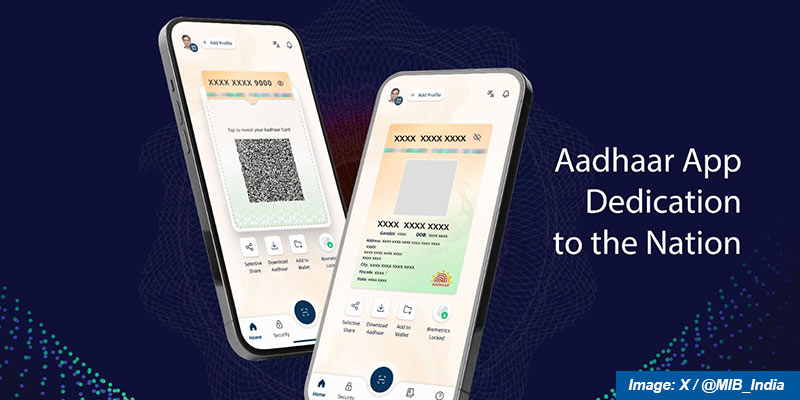
Minister of State for Commerce and Industry and Electronics & Information Technology Jitin Prasada dedicated the new Aadhaar app to the nation on January 28.
What are the features of new Aadhaar app?
• Developed by the Unique Identification Authority of India (UIDAI), the Aadhaar app is a next-generation mobile application designed to provide Aadhaar Number Holders (ANH) with a secure, convenient and privacy-first way to carry, share, show and verify their digital identity.
• Designed for ease of use across the entire spectrum of users, the Aadhaar app supports a wide range of real-life use cases.
• These include hotel check-ins through Offline Verification Seeking Entity’s (OVSE) QR code scanning.
• It allows optional face verification, age verification for cinema ticket bookings, hospital admissions for visitors and attendants, verification of gig workers and service partners among many such use cases.
• The app also includes advanced functionalities such as face verification for proof of presence, biometric lock/unlock in a single click, viewing of authentication history, and a QR-based contact card for easy sharing of contact details.
• It allows management of up to five Aadhaar profiles on a single device, enabling the concept of ‘One Family – One App’.
• In addition to address updates, residents can now update their registered mobile number through the app, with more update services planned in the future.
• Another key feature of the app is selective credential sharing. People can share only the specific identity fields required for a particular use case through customised QR codes generated by requesting entities.
• This ensures that Aadhaar numbers are not stored by verifiers and only digitally signed verifiable credentials are shared, promoting data minimisation in line with the Digital Personal Data Protection (DPDP) Act.
• The new app also comes with a contact card that enables users to share their contact with other people instead of sharing paper-based cards.
Unique Identification Authority of India (UIDAI)
• The Unique Identification Authority of India (UIDAI) is a statutory authority established under the provisions of the Aadhaar (Targeted Delivery of Financial and Other Subsidies, Benefits and Services) Act, 2016 (Aadhaar Act, 2016) on July 12, 2016 by the government of India, under the ministry of electronics and information technology (MeitY).
• The Aadhaar Act, 2016 has been amended by the Aadhaar and Other Laws (Amendment) Act, 2019.
• Prior to its establishment as a statutory authority, UIDAI was functioning as an attached office of the then Planning Commission (now NITI Aayog).
• On September 12, 2015, the government revised the Allocation of Business Rules to attach the UIDAI to the Department of Electronics & Information Technology (DeitY).
• UIDAI was created with the objective to issue Unique Identification numbers (UID), named as Aadhaar, to all residents of India.
• UIDAI has its headquarters in New Delhi and functions through its eight regional offices situated in Bengaluru, Chandigarh, Guwahati, Hyderabad, Lucknow, Mumbai, New Delhi and Ranchi.
• UIDAI has two data centres – one at Hebbal (Bengaluru) in Karnataka and the other at Manesar (Gurugram) in Haryana.
• The first UID number was issued on September 29, 2010 to a resident of Nandurbar in Maharashtra.
What is Aadhaar?
• Aadhaar is a 12-digit unique ID issued to an individual. Aadhaar uses demographic information (name, date of birth, gender and address), photograph of the face, fingerprints and iris to identify a resident. These items of information are mandatory.
• The objective of Aadhaar is to empower residents of India with a unique identity and digital platform only for the purpose of identity proof.
• Aadhaar number is a proof of identity. It does not confer any right of citizenship or domicile in respect of an Aadhaar number holder.
• Under the Aadhaar Act, 2016, UIDAI is responsible for Aadhaar enrolment and authentication, including operation and management of all stages of Aadhaar life cycle, developing the policy, procedure and system for issuing Aadhaar numbers to individuals and perform authentication and the security of identity information and authentication records of individuals.
(The author is a trainer for Civil Services aspirants.)