
- India
- Jan 31
- Sreesha V.M
Menstrual health is fundamental right, rules SC
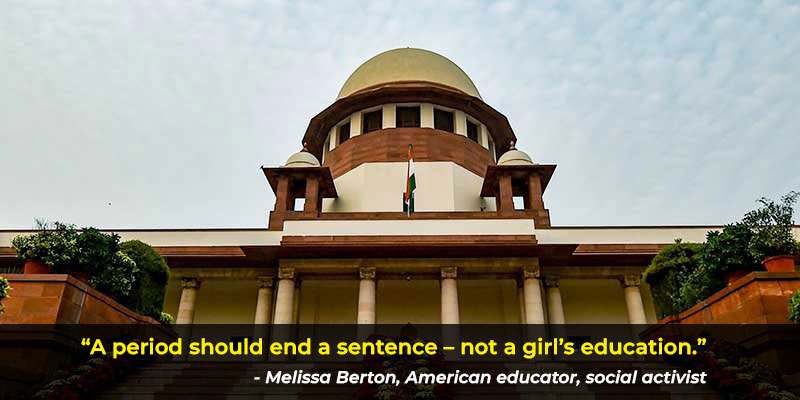
• The Supreme Court declared the right to dignified menstrual health as part of the right to life and education under the Constitution in a judgment on January 30.
• The apex court directed all states and Union Territories to provide free oxo-biodegradable sanitary napkins to girl students and functional, gender-segregated toilets for all the students.
• In a judgment to ensure gender justice and educational equity, a bench comprising Justices J.B. Pardiwala and R Mahadevan issued a slew of directions to all states and UTs to ensure that these facilities are provided in schools irrespective of whether they are government-run, aided or private.
• The verdict warns of stringent consequences for non-compliance, including the derecognition of private schools and holding state governments directly accountable for failures in public institutions.
PIL filed under Article 32 of the Constitution
The petitioner, Jaya Thakur, who is a social worker, filed the petition under Article 32 of the Constitution in public interest seeking appropriate directions to the respondents – the Union of India, the States and Union Territories respectively to ensure providing of:
i) Free sanitary pads to every female child studying between classes 6 & 12.
ii) A separate toilet for females in all government aided and residential schools.
What is Article 32?
• In Part III of the Constitution, Article 32 deals with Right to Constitutional Remedies.
• Article 32 gives an extensive original jurisdiction to the Supreme Court in regard to enforcement of Fundamental Rights. It is empowered to issue directions, orders or writs, including writs in the nature of habeas corpus, mandamus, prohibition, quo warranto and certiorari to enforce them.
It states that:
(1) The right to move the Supreme Court by appropriate proceedings for the enforcement of the rights conferred by this Part is guaranteed.
(2) The Supreme Court shall have power to issue directions or orders or writs, including writs in the nature of habeas corpus, mandamus, prohibition, quo warranto and certiorari, whichever may be appropriate, for the enforcement of any of the rights conferred by this Part.
(3) Without prejudice to the powers conferred on the Supreme Court by clauses (1) and (2), Parliament may by law empower any other court to exercise within the local limits of its jurisdiction all or any of the powers exercisable by the Supreme Court under clause (2).
(4) The right guaranteed by this Article shall not be suspended except as otherwise provided for by this Constitution.
Article which has been described as the heart and soul of the Constitution
A statement of B.R. Ambedkar has been specifically reiterated in several judgments of the Supreme Court to emphasise the unique significance attributed to Article 32 in our constitutional scheme.
“If I was asked to name any particular Article in this Constitution as the most important, an Article without which this Constitution would be a nullity, I could not refer to any other Article except this one. It is the very soul of the Constitution and the very heart of it,” Ambedkar had said during the Constituent Assembly debates in 1948.
Menstruation as a barrier to the right to access education
• In a research conducted on whether schools across the territory of India are menstrual-hygiene friendly, the researchers found that more than half of the girls did not have information about menstruation prior to menarche.
• The research revealed that the lack of sanitation facilities in schools hindered the ability of girls to manage menstruation healthily, safely, and with dignity.
• Similarly, the Clean India: Clean Schools Handbook reported that although the number of schools providing drinking water and toilets have increased yet poor maintenance has left them inaccessible.
• The inaccessibility was attributed to factors such as absence of dedicated funds for operation and maintenance, weak management, poor quality of construction, and the lack of availability of water within toilets.
• The Handbook further reported that menstrual hygiene management is absent in a majority of schools, including the lack of gender-specific infrastructure, access to sanitary napkins, and a disposal mechanism.
• In another research, the researchers found that nearly one-third of girls were absent from school due to issues related to menstrual health, restrictive societal norms, and inadequate menstrual hygiene management.
• Among the reported reasons for absence, dysmenorrhea (painful menstrual periods) was the most prevalent, followed by restrictions at home, fear of staining clothes and difficulty in changing sanitary pads at school.
• The findings of the study revealed that students in government schools were more likely to be absent as compared to those in private schools.
• Notably, girls using hygienic methods reported lower absenteeism as compared to others.
• The right to education as a human right does not merely demand parity between genders but further requires equality of opportunity in the enjoyment of that right for all.
• Inaccessibility of menstrual hygiene management measures perpetuates a systemic exclusion and discrimination that impacts the admission or continuation of girl children in school.
The right to menstrual health as a facet of the right to life
• Article 21 recognises the right to health. Health is defined as a state of physical, mental, and social well-being and not merely the absence of disease or infirmity.
• By necessary implication, this right will impliedly extend to the right of a menstruating girl child to access menstrual hygiene management practices to attain the highest standard of sexual and reproductive health.
• They are intertwined in such a manner that one cannot survive without the other.
• The right to reproductive health implies that an adolescent female student should have access to safe, effective, and affordable menstrual hygiene management measures.
• Poor menstrual hygiene may cause reproductive tract infections such as bacterial vaginosis, which may in turn lead to infertility.
Key directions issued by the Supreme Court:
• All states and Union Territories shall ensure that every school, whether government-run or privately managed, in both urban and rural areas, is provided with functional, gender-segregated toilets with usable water connectivity.
• All the existing and newly constructed toilets in schools shall be designed, constructed, and maintained so as to ensure privacy and accessibility, including by catering to the needs of children with disabilities.
• All school toilets shall be equipped with functional handwashing facilities, with soap and water available at all times.
• States and UTs shall ensure that every school provides oxo-biodegradable sanitary napkins manufactured in compliance with the ASTM D-6954 standards free of cost.
• Every school shall establish Menstrual Hygiene Management (MHM) corners. Such MHM corners shall be equipped with, including but not limited to, spare innerwear, spare uniforms, disposable bags, and other necessary materials to address menstruation-related exigencies.
• The National Council of Educational Research and Training (NCERT) and the State Council of Educational Research and Training (SCERT) shall incorporate gender responsive curricula, more particularly, on menstruation, puberty, and other related health concerns, with a view to break stigma and taboo associated with menstrual health and hygiene.
• All teachers, whether male or female, shall be adequately trained and sensitised on menstrual hygiene, including appropriate ways of supporting and assisting menstruating students.
(The author is a trainer for Civil Services aspirants.)