
- India
- Jan 31
India now has 98 Ramsar Sites
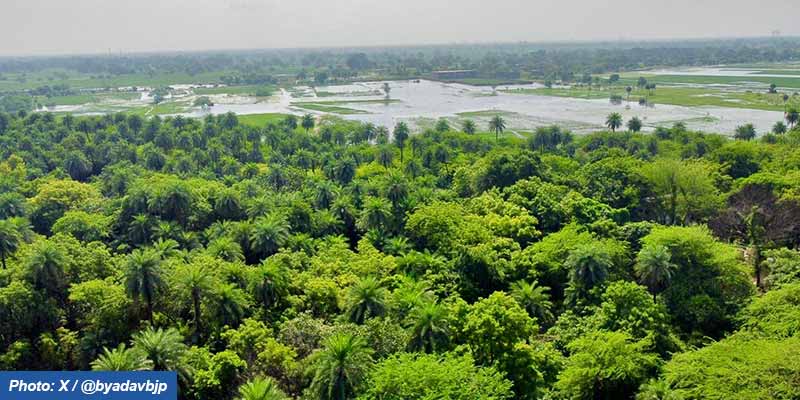
• Patna Bird Sanctuary in Uttar Pradesh’s Etah and Chhari-Dhand in Gujarat’s Kutch have been recognised as Ramsar sites.
• The designation of these two sites under the Ramsar Convention takes the total number of such wetlands in India to 98.
Patna Bird Sanctuary
• It is located in Etah district of Uttar Pradesh.
• The Site consists of freshwater marshes, woodlands and grasslands, and is surrounded by agricultural landscape.
• Together, these different landscapes create a wide range of habitats and support a high level of biodiversity, reflected in the 178 bird species and 252 plant species recorded at the Site.
• Patna Bird Sanctuary is particularly important in supporting waterbird populations and has been designated an Important Bird and Biodiversity Area (IBA) by BirdLife International.
• The Site also provides habitat for larger species, such as the regionally characteristic and vulnerable broad-snouted crocodile (Crocodylus palustris).
• The area is an important destination for religious tourism and nature-based recreation.
• However, these activities exert pressure on the Site, as do threats from invasive species.
• Conservation measures are being implemented to address these challenges, including regular removal of invasive plants, regulation and monitoring of tourism activities, and ongoing monitoring of migratory birds and avian influenza.
Chhari-Dhand
• The Site is a seasonal saline wetland located between the arid grasslands of Banni and the salt flats of Kachchh in Gujarat.
• It floods during the monsoon season, forming extensive water bodies that provide important habitat for a wide range of plant and animal species.
• Notable plants at the Site include Indian gum tragacanth (Sterculia urens) and the critically endangered Indian bdellium-tree (Commiphora wightii), both of which are adapted to arid conditions and characteristic of the region.
• The Site is also an important wintering ground for waterfowl, supporting species such as the critically endangered sociable lapwing (Vanellus gregarius), the vulnerable common pochard (Aythya ferina) and, notably, approximately 30,000 common cranes (Grus grus) annually.
What is the Ramsar Convention?
• The Ramsar List is the world’s largest network of protected areas. There are over 2,500 Ramsar Sites, covering more than 2.5 million square kilometres.
• The Ramsar Convention is an international treaty signed by 173 countries to protect wetlands.
• It is named after the city in Iran where it was signed, and it began with 18 countries in 1971.
• The convention is one of the oldest inter-governmental accords for preserving the ecological character of wetlands. Also known as the Convention on Wetlands, it aims to develop a global network of wetlands for the conservation of biological diversity and for sustaining human life.
• It is one of the largest international agreements, after the Convention on Biological Diversity (CBD, 196 countries) and the UN climate agreement (UNFCCC, 197 countries).
• India ratified the convention on February 1, 1982.
• The first Site was the Cobourg Peninsula in Australia, designated in 1974. The largest Sites are Rio Negro in Brazil (120,000 sq km), and Ngiri-Tumba-Maindombe in the Democratic Republic of Congo and Queen Maud Gulf in Canada. These Sites each cover over 60,000 sq km.
• The countries with the most Sites are the United Kingdom with 176 and Mexico with 144. Brazil has the largest area with 267,000 square km under the Convention protection; Bolivia, Canada, Chad, Congo, the Democratic Republic of Congo and the Russian Federation have also each designated over 100,000 square km.
What are wetlands?
• Wetlands are ecosystems where water is the primary factor controlling the environment and the associated plant and animal life.
• Wetlands are land areas that are saturated or flooded with water either permanently or seasonally. Inland wetlands include marshes, ponds, lakes, fens, rivers, floodplains and swamps.
• Coastal wetlands include saltwater marshes, estuaries, mangroves, lagoons and even coral reefs. Fish ponds, rice paddies and saltpans are man-made wetlands.
• Wetlands provide a wide range of important resources and ecosystem services such as food, water, fibre, groundwater recharge, water purification, flood moderation, erosion control and climate regulation.
• They are, in fact, a major source of water and our main supply of freshwater comes from an array of wetlands which help soak rainfall and recharge groundwater.
• Though they cover only around 6 per cent of the Earth’s land surface, 40 per cent of all plant and animal species live or breed in wetlands.
• Wetland biodiversity matters for our health, our food supply, for tourism and for jobs. Wetlands are vital for humans, for other ecosystems and for our climate, providing essential ecosystem services such as water regulation, including flood control and water purification.
• More than a billion people across the world depend on wetlands for their livelihoods – that’s about one in eight people on Earth.
• Every year, February 2 is observed as World Wetlands Day to raise global awareness about the vital role of wetlands for our planet. This day also marks the date of the adoption of the Convention on Wetlands on February 2, 1971, in Ramsar, Iran.