
- India
- Feb 02
16th Finance Commission adds new criteria for tax devolution
• In her Budget Speech, Finance Minister Nirmala Sitharaman said the government has accepted the recommendation of the 16th Finance Commission to retain the vertical share of devolution at 41 per cent.
• The Centre has provided Rs 1.4 lakh crore to the states for the FY 2026-27 as Finance Commission Grants, as recommended by the Commission.
• These include Rural and Urban Local Body and Disaster Management Grants.
• The 16th Finance Commission, headed by former Vice-Chairman of the NITI Aayog Arvind Panagariya, submitted its report to President Droupadi Murmu on November 17, 2025.
• The Report of the Commission covering the financial years 2026-27 to 2030-31 commencing from April 1, 2026, together with Explanatory Memorandum as to the action taken on the recommendations of the Commission, was tabled in the Parliament, in pursuance of Article 281 of the Constitution.
Devolution Criteria
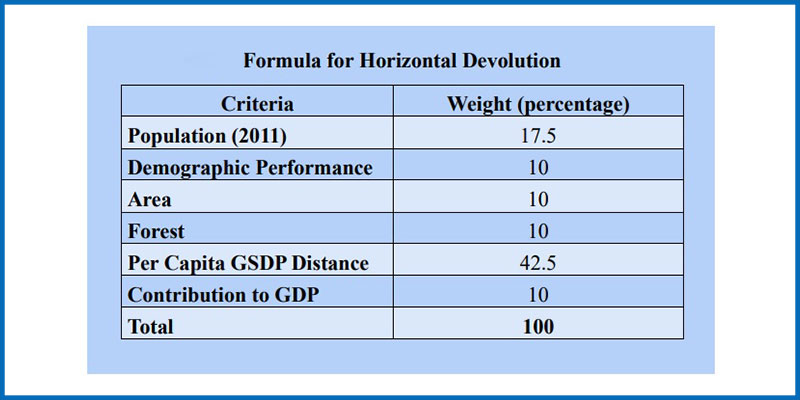
Five criteria that have been employed by previous Finance Commissions are:
1) Population
2) Demography
3) Area
4) Forest
5) Per‑capita‑GSDP‑distance.
• For the first time, this Commission decided to add the state’s contribution to GDP among its horizontal devolution criteria.
• Many States have also recommended the inclusion of this criterion.
• The Commission defines the state’s contribution to GDP by the share of its Gross State Domestic Product (GSDP) in all states’ GSDP.
• In implementing the criterion, however, the Commission found that these contributions are dispersed very widely, especially at the top and bottom ends, giving rise to large differences in the implied devolutions to the states.
• To moderate these differences, the Commission modified the criterion by defining the state’s share as the ratio of square root of its GSDP to sum of square root of GSDP of all states.
• A weight of 10 per cent is assigned to this criterion.
• The Commission noted that just as the per capita GSDP distance serves as a surrogate for other equity‑related criteria such as poverty and SDG achievements, the contribution to GDP serves as a surrogate for efficiency‑based criteria such as tax effort and fiscal discipline.
• Based on the above criteria and weights, the Commission has worked out the shares of the 28 states in the portion of the divisible pool assigned to the states.

What is the Finance Commission?
• The Finance Commission is a constitutional body to provide suggestions on Centre-state financial relations.
• The Finance Commission is constituted by the President under Article 280 of the Constitution, mainly to give its recommendations on distribution of tax revenues between the Union and the states and among the states themselves.
• The 15th Finance Commission was constituted on November 27, 2017 against the backdrop of the abolition of the Planning Commission (as also of the distinction between Plan and non-Plan expenditure) and the introduction of the Goods and Services Tax (GST), which has fundamentally redefined federal fiscal relations.
• In November 2020, the 15th Finance Commission, led by chairman N.K. Singh, submitted its report for the period 2021-22 to 2025-26 to the then President Ram Nath Kovind.
• On December 31, 2023, the government appointed former vice chairman of NITI Aayog Arvind Panagariya as the chairman of the 16th Finance Commission.
Members of the Commission are:
i) Annie George Mathew
ii) Manoj Panda
iii) T. Rabi Sankar
iv) Soumya Kanti Ghosh
• Ritvik Ranjanam Pandey was named as the secretary to the Commission.
What are the functions of Finance Commission?
Two distinctive features of the commission’s work involve redressing the vertical imbalances between the taxation powers and expenditure responsibilities of the Centre and the states respectively and equalisation of all public services across the states.
It makes recommendations on:
i) The distribution between the Union and the states of the net proceeds of taxes (the divisible pool) that are to be, or may be, divided between them and the allocation between the states of the respective shares of such proceeds.
ii) The principles that should govern the grants-in-aid of the revenues of the states out of the Consolidated Fund of India.
iii) The measures needed to augment the consolidated fund of a state to supplement the resources of the panchayats in the state on the basis of the recommendations made by the Finance Commission of the state.
iv) The measures needed to augment the consolidated fund of a state to supplement the resources of the municipalities on the basis of the recommendations made by the Finance Commission of the state.
What are the qualifications required for its members?
As per the provisions contained in the Finance Commission (Miscellaneous Provisions) Act, 1951, and The Finance Commission (Salaries & Allowances) Rules, 1951, the chairman of the commission is selected from among persons who have had experience in public affairs, and the four other members are selected from among persons who:
(a) are, or have been, or are qualified to be appointed as judges of a High Court or
(b) have special knowledge of the finances and accounts of government or
(c) have had wide experience in financial matters and in administration or
(d) have special knowledge of economics.
When was the first Finance Commission constituted?
The First Finance Commission was constituted by a presidential order under the chairmanship of K.C. Neogy on April 6, 1952.
Do other countries have such commissions?
Most federal systems resolve the vertical and horizontal imbalances through mechanisms similar to the Finance Commission. For example, Australia and Canada.
Constitutional provisions under which Finance Commission acts:
• Article 268 - Duties levied by the Union but collected and appropriated by the states.
• Article 269 - Taxes levied and collected by the Union but assigned to the states.
• Article 270 - Taxes levied and collected by the Union and distributed between the Union and the states.
• Article 271 - Surcharge on certain duties and taxes for purposes of the Union.
• Article 274 - Prior recommendation of the President required to Bills affecting taxation in which states are interested.
• Article 275 - Grants from the Union to certain states.
• Article 280 - Constituting the Finance Commission.
• Article 281 - Recommendations of the Finance Commission.
• Article 282 - Expenditure defrayable by the Union or a state out of its revenues.