
- India
- Feb 02
- Sreesha V.M
What is Orange Economy?
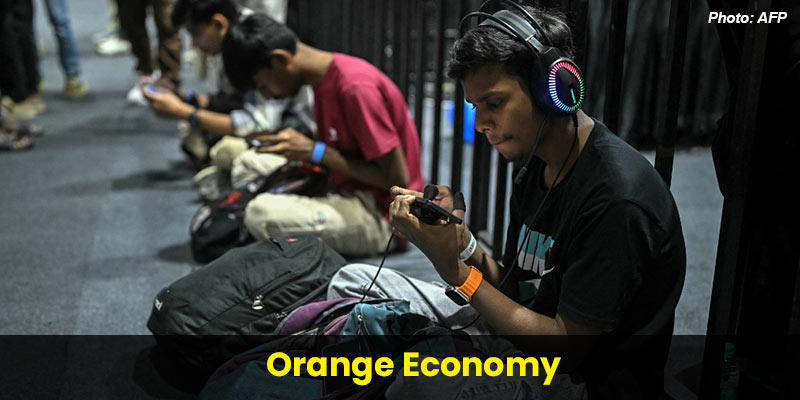
• In the 2026-27 Union Budget, Finance Minister Nirmala Sitharaman outlined key initiatives to promote the Orange Economy and strengthen the country’s creative industries.
• Highlighting the rapid growth of India’s animation, visual effects, gaming and comics (AVGC) sector, Sitharaman noted that the industry is projected to require nearly two million professionals by 2030.
• To support this expanding ecosystem, she proposed assistance to the Indian Institute of Creative Technologies, Mumbai, for setting up AVGC Content Creator Labs in 15,000 secondary schools and 500 colleges across the country.
• These labs are expected to unlock new creative career opportunities for youth.
• The initiative marks a significant push towards building a future-ready workforce, strengthening India’s creative economy, and expanding opportunities for learners across the country.
What is ‘Orange Economy’?
• The ‘orange economy’is also known as the creative economy.
• It refers to the part of the economy driven by creativity, culture and intellectual property, where value comes mainly from ideas, knowledge, artistic expression and cultural content rather than physical goods.
• It is an evolving concept based on the contribution and potential of creative assets to contribute to economic growth and development.
• The creative economy encompasses creating, producing, and distributing goods and services that use creativity and intellectual capital as primary inputs.
• The creative industries — which include advertising, architecture, arts and crafts, design, fashion, film, video, photography, music, performing arts, publishing, research & development, software, computer games, electronic publishing, and TV/radio — are the lifeblood of the creative economy.
• The creative economy is the sum of all the parts of the creative industries, including trade, labour and production.
• These industries encompass knowledge-based activities focusing on culture and heritage, including tangible and intangible creative products with economic value.
• The creative economy drives economic growth, supports job creation, and fosters social inclusion and cultural diversity.
• It emphasises integrating economic, cultural, and social aspects with technology and intellectual property.
• According to a report by UNESCO, cultural and creative industries generate annual revenues of almost $2.3 trillion globally, contributing 3.1 per cent of the global gross domestic product (GDP).
• In addition, UNESCO estimates that the cultural and creative industries account for 6.2 per cent of global employment.
• Key trends in the sector include the rise of digital platforms and streaming services, increasing cross-industry collaborations, and the growing popularity of video games across various sectors.
• Digitalisation is a critical driver of the creative economy, with artificial intelligence playing a crucial role in transforming creative industries.
• Digitalisation also supports emerging business models such as streaming and digital platforms and fosters cross-industry collaborations (e.g., between video game companies, musicians, publishers, and film studios) and gamification across sectors.
• While digitalisation and artificial intelligence offer opportunities for growth and efficiency, they also raise concerns about quality, copyright, privacy, and content monopolisation.
• However, some creative industries are highly concentrated, leading to market concentration and hindering fair competition.
(The author is a trainer for Civil Services aspirants.)