
- India
- Feb 03
- Sreesha V.M
India takes part in the 64th Session of Commission for Social Development
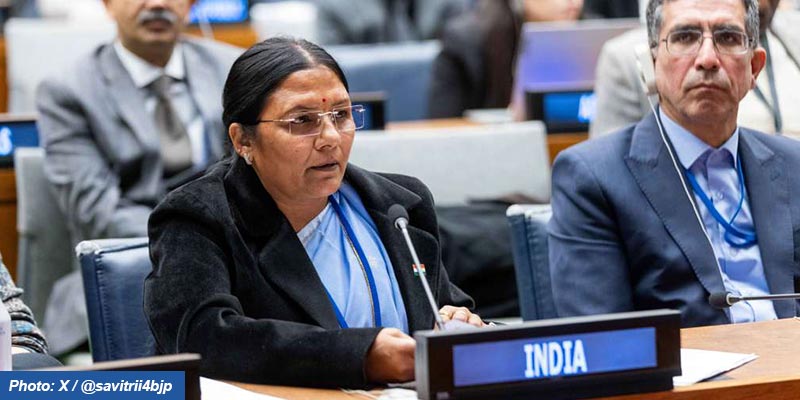
• Minister of State for Women and Child Development Savitri Thakur delivered India’s national statement at the 64th Session of the Commission for Social Development (CSocD) at UN headquarters in New York on February 2.
• The minister emphasized that social justice and social protection in India are rooted in constitutional guarantees and aligned with the country’s long-term vision of “Viksit Bharat @2047”.
• She outlined key national initiatives demonstrating scale, inclusion, and last-mile delivery.
• India also highlighted the role of digital public infrastructure and Direct Benefit Transfers (DBT) in enhancing transparency, efficiency, and accountability in public service delivery.
• Emphasizing that global challenges require collective responses, India expressed support for strengthened multilateral cooperation, capacity building, and South-South collaboration to accelerate progress on social development models.
• The 64th session of the Commission for Social Development (CSocD64) is being held from February 2 to 10 in United Nations Headquarters, New York.
• This year’s theme is ‘Advancing Social Development and Social Justice through Coordinated, Equitable, and Inclusive Policies’.
• The session is presided over by the chair of the commission Khrystyna Hayovyshyn, permanent representative of Ukraine to the UN.
• India’s participation in the 64th session reflects its continued engagement with multilateral efforts on social development and its commitment to constructive dialogue on global social policy priorities.
Commission for Social Development
• The Commission for Social Development (CSocD) is one of the eight functional commissions established by the United Nations Economic and Social Council (ECOSOC) since 1946 to advise and assist it in carrying out its work.
• It was originally known as the Social Commission, but renamed in 1966.
• Originally 18, membership has been increased several times, and now stands at 46.
• Members are elected by ECOSOC based on equitable geographical distribution for four-year terms.
• India’s term in CSocD will expire in 2027.
• The purpose of the commission is also to advise the ECOSOC on social policies of a general character and, in particular, on all matters in the social field not covered by the specialised inter-governmental agencies.
• CSocD meets annually in New York.
• Each year, the CSocD adopts a priority theme and an emerging issue to guide its work and discussions.
The Copenhagen connection
• At the World Summit for Social Development, held in March 1995 in Copenhagen, governments reached a new consensus on the need to put people at the centre of development.
• The Summit was the largest gathering ever of world leaders at that time. It pledged to make the conquest of poverty, the goal of full employment and the fostering of social integration overriding objectives of development.
• At its conclusion, governments adopted a ‘Declaration and Programme of Action’ which represented a new consensus on the need to put people at the centre of development.
• Following the World Summit for Social Development in Copenhagen, the CSocD has been the key United Nations body in charge of the follow up and implementation of the Copenhagen Declaration and Programme of Action.
(The author is a trainer for Civil Services aspirants.)