
- India
- Feb 03
- Sreesha V.M
Govt to conduct migration survey during July 2026-June 2027
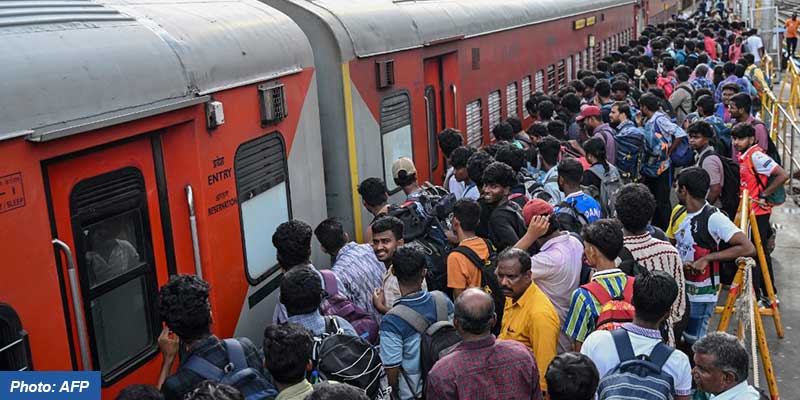
• The National Statistics Office (NSO), under the Ministry of Statistics and Programme Implementation (MoSPI), has proposed to conduct a survey on migration during July 2026-June 2027.
• Migration surveys have been conducted by MoSPI in regular intervals.
• The most recent data on migration were collected through the Periodic Labour Force Survey (PLFS) 2020–21 and the Multiple Indicator Survey (2020–21).
The objective of the proposed migration survey is to generate estimates broadly on the following indicators:
i) Migration rate
ii) Rate of out-migration
iii) Short-term migration rate
iv) Reason for migration
v) Net migration.
Definition of a migrant
• Mobility is an inherent aspect of human life. However, not all forms of mobility qualify as migration.
• In the National Sample Survey (NSS), migration is defined as movements that involve a change in the usual place of residence (UPR) of an individual.
• Usual place of residence (UPR) of a person is defined as a place (village/town) where the person has stayed continuously for a period of six months or more.
• Accordingly, a household member whose last UPR differs from the current place of enumeration is considered a migrant.
• Migration is influenced by a wide range of factors — social, cultural, political, personal, and environmental.
• However, migration as an economic phenomenon often receives particular attention.
• People frequently move in search of better livelihood opportunities, either due to unemployment or underemployment in their current location, or in the hope of securing improved prospects elsewhere.
• In addition to permanent or semi-permanent migration, other forms of mobility exist that do not entail a change in the usual place of residence.
• These are typically short-term or seasonal movements, often linked to employment-related factors, and play a significant role in the overall dynamics of population mobility.
• The forthcoming Survey on Migration is expected to provide comprehensive and up-to-date data on the extent and patterns of migration, both rural and urban and inter-state, along with reasons for migration, return migration, seasonal migration, employment profiles of migrants, etc.
• The results will be instrumental in understanding labour mobility, remittance flows, etc.
• Such information will greatly benefit policymakers, planners, researchers, and development practitioners by enabling more targeted interventions in areas such as urban planning, housing, transportation, employment generation, social security and skill development.
Results of previous survey
• According to the Periodic Labour Force Survey (PLFS) conducted during July 2020-June 2021, the migration rate in India was estimated at 28.9 per cent.
• The migration rate among males was estimated at 10.7 per cent and 47.9 per cent among females.
• Marriage accounted for the predominant share of migration, contributing about 86.8 per cent of all female migrants.
• In contrast, among males, migration in search of employment or better employment constitutes the highest share at 22.8 per cent at the all-India level.
(The author is a trainer for Civil Services aspirants.)