
- India
- Feb 04
- Sreesha V.M
DRDO successfully demonstrates SFDR tech in long-range missiles
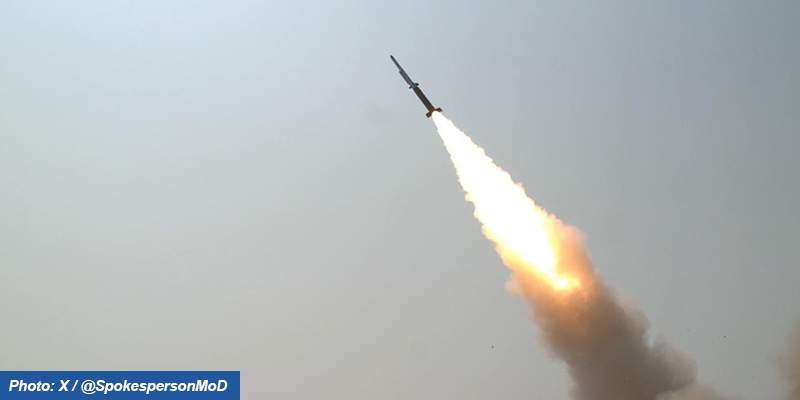
• Defence Research & Development Organisation (DRDO) carried out a successful demonstration of Solid Fuel Ducted Ramjet (SFDR) technology from the Integrated Test Range (ITR), Chandipur off the coast of Odisha on February 3.
• SFDR is a missile propulsion system and is required for long-range air-to-air missiles being developed by DRDO.
• It can also be used for surface-to-air missiles.
• The successful demonstration places India into an elite league of nations possessing this technology that enables developing long-range air-to-air missiles to give tactical edge over the adversaries.
What is scramjet?
• Ramjet, Scramjet and Dual Mode Ramjet (DMRJ) are the three concepts of air-breathing engines which are being developed by various space agencies.
• A ramjet is a form of air-breathing jet engine that uses the vehicle’s forward motion to compress incoming air for combustion without a rotating compressor. Fuel is injected in the combustion chamber where it mixes with the hot compressed air and ignites. A ramjet-powered vehicle requires an assisted take-off like a rocket assist to accelerate it to a speed where it begins to produce thrust.
• Ramjets work most efficiently at supersonic speeds around Mach 3 (three times the speed of sound) and can operate up to speeds of Mach 6.
• However, the ramjet efficiency starts to drop when the vehicle reaches hypersonic speeds.
• A scramjet engine is an improvement over the ramjet engine as it efficiently operates at hypersonic speeds and allows supersonic combustion. Thus it is known as Supersonic Combustion Ramjet, or Scramjet.
• A dual mode ramjet (DMRJ) is a type of jet engine where a ramjet transforms into a scramjet over Mach 4-8 range, which means it can efficiently operate both in subsonic and supersonic combustor modes.
How was the test conducted?
• All the sub-systems, including nozzle-less booster, solid fuel ducted ramjet motor and fuel flow controller, performed as per expectations after being initially propelled by a ground booster motor to the desired Mach number.
• The performance of the system was confirmed by the flight data captured by a number of tracking instruments deployed by ITR, Chandipur along the coast of the Bay of Bengal.
• The launch was monitored by senior scientists from various laboratories of DRDO, including Defence Research and Development Laboratory, High Energy Materials Research Laboratory, Research Centre Imarat and ITR.
(The author is a trainer for Civil Services aspirants.)