
- India
- Feb 01
- Sreesha V.M
Sitharaman presents her ninth straight Union Budget
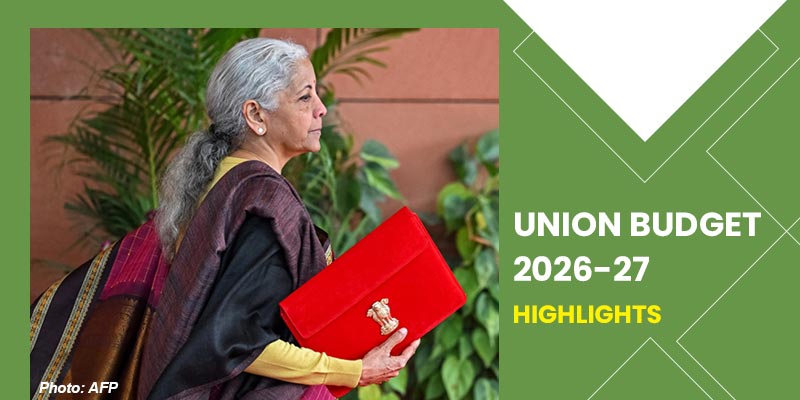
• Finance Minister Nirmala Sitharaman presented the Union Budget 2026-27 on February 1.
• It was her ninth straight Union Budget.
• Former Prime Minister Morarji Desai had presented the Union Budget on 10 occasions, while P Chidambaram presented the Budget nine times, but not for consecutive years.
• Sitharaman announced measures to boost manufacturing, offered long-term tax incentives for global data centres, and support for agriculture and tourism as she unveiled a Rs 53.5 lakh crore Union Budget for 2026-27.
• In 2026-27, the non-debt receipts and the expenditure are estimated as Rs 36.5 lakh crore and Rs 53.5 lakh crore respectively.
• The Centre’s net tax receipts are estimated at Rs 28.7 lakh crore.
• To finance the fiscal deficit, the net market borrowings from dated securities are estimated at Rs 11.7 lakh crore.
• The balance financing is expected to come from small savings and other sources. The gross market borrowings are estimated at Rs 17.2 lakh crore.
Three Kartavyas
• Sitharaman proposed three kartavyas to speed-up the reform momentum towards Viksit Bharat.
1) The first Kartavya is to accelerate and sustain economic growth, by enhancing productivity and competitiveness, and building resilience to volatile global dynamics.
Proposed interventions in six areas to accelerate and sustain economic growth:
a) Scaling up manufacturing in seven strategic and frontier sectors.
b) Rejuvenating legacy industrial sectors.
c) Creating ‘Champion MSMEs’
d) Delivering a powerful push to infrastructure
e) Ensuring long-term energy security and stability
f) Developing City Economic Regions.
2) The second Kartavya is to fulfill aspirations of people and build their capacity, making them strong partners in India’s path to prosperity.
The government has decided to place a renewed emphasis on the services sector to provide a pathway to fulfilling aspirations of a youthful India, with measures like setting up a high-powered ‘Education to Employment and Enterprise’ standing committee to recommend measures that focus on the services sector as a core driver of Viksit Bharat. The committee will prioritise areas to optimise the potential for growth, employment and exports. They will also assess the impact of emerging technologies, including AI, on jobs and skill requirements and propose measures thereof.
3) The third Kartavya, aligned with the vision of ‘Sabka Sath, Sabka Vikas’, is to ensure that every family, community, region and sector has access to resources, amenities and opportunities for meaningful participation.
Proposed targeted efforts for:
a) Increasing farmer incomes through productivity enhancement and entrepreneurship, with special attention to small and marginal farmers.
b) Empowering ‘divyangjan’ through access to livelihood opportunities, training and high-quality assistive devices.
c) Empowering the vulnerable to access mental health and trauma care
d) Focus on the Purvodaya states and the northeast region to accelerate development and employment opportunities.
Key announcements:
• The New Income tax Act, 2025 will come into effect from April 2026. Also the simplified Income Tax Rules and Forms will be notified shortly. The forms for the purpose are redesigned for easy compliance of ordinary citizens.
• To develop India as a global biopharma manufacturing hub, Biopharma SHAKTI with an outlay of Rs 10,000 crore to build the ecosystem for domestic production of biologics and biosimilars will be set up over the next five years.
• To promote environmentally sustainable passenger systems, seven high-speed rail corridors between cities will be developed as ‘growth connectors’.
These are:
i) Mumbai-Pune
ii) Pune-Hyderabad
iii) Hyderabad-Bengaluru
iv) Hyderabad-Chennai
v) Chennai-Bengaluru
vi) Delhi-Varanasi
vii) Varanasi-Siliguri.
• Announced the launch of India Semiconductor Mission (ISM) 2.0 to produce equipment and materials, design full stack Indian IP, and fortify supply chains. The focus will be on industry led research and training centres to develop technology and skilled workforce. Provision of Rs 1,000 crore has been made towards this for FY 2026-27.
• The Electronics Components Manufacturing Scheme (ECMS), launched in April 2025 with an outlay of Rs 22,919 crore, already has investment commitments at double the target. It has now been proposed to increase the outlay to Rs 40,000 crore to capitalise on the momentum.
• To promote India as a hub for medical tourism services, a scheme is proposed to support states in establishing five regional medical hubs, in partnership with the private sector. These hubs will serve as integrated healthcare complexes that combine medical, educational and research facilities.
• Taking forward the systematic nurturing of sports talent which is set in motion through the Khelo India programme, Sitharaman proposed to launch a Khelo India Mission to transform the Sports sector over the next decade.
• Proposed Bharat-VISTAAR (Virtually Integrated System to Access Agricultural Resources), a multilingual AI tool that shall integrate the AgriStack portals and the ICAR package on agricultural practices with AI systems. This will enhance farm productivity, enable better decisions for farmers and reduce risk by providing customised advisory support.
• Self-Help Entrepreneur (SHE) Marts will be set up as community-owned retail outlets within the cluster level federations through enhanced and innovative financing instruments.
• Proposed the development of an integrated East Coast Industrial Corridor with a well-connected node at Durgapur, creation of five tourism destinations in the five Purvodaya States, and the provision of 4,000 e-buses.
• Proposed to launch a scheme for development of Buddhist Circuits in Arunachal Pradesh, Sikkim, Assam, Manipur, Mizoram and Tripura. The Scheme will cover preservation of temples and monasteries, pilgrimage interpretation centers, connectivity and pilgrim amenities.
• For the labour-intensive textile sector, an integrated programme with five sub-parts was proposed.
• Recognising MSMEs as a vital engine of growth, a dedicated Rs 10,000 crore SME Growth Fund was proposed to create future Champions, incentivising enterprises based on select criteria.
• Proposed to provide tax holiday till 2047 to any foreign company that provides cloud services to customers globally by using data centre services from India. It will, however, need to provide services to Indian customers through an Indian reseller entity.
(The author is a trainer for Civil Services aspirants.)