
- India
- Feb 06
Centre signs tripartite MoU to create Frontier Nagaland Territorial Authority
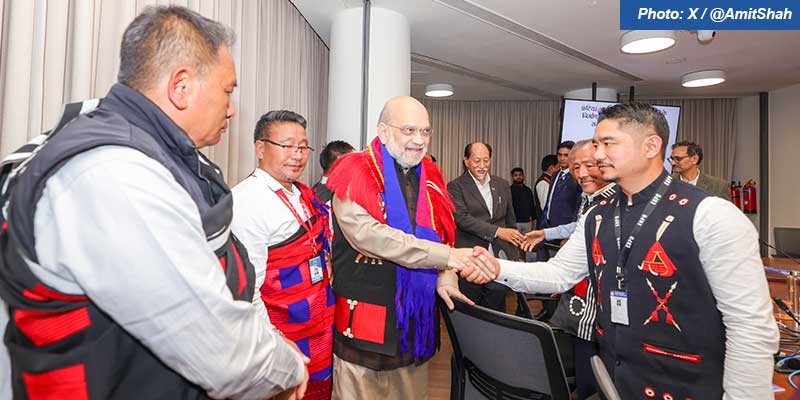
• A historic agreement was signed between the government of India, government of Nagaland and representatives of Eastern Nagaland Peoples’ Organisation (ENPO) in New Delhi on February 5.
• The agreement will pave the way for creation of Frontier Nagaland Territorial Authority (FNTA) for six districts of Nagaland — Tuensang, Mon, Kiphire, Longleng, Noklak and Shamator, and devolution of powers in respect of 46 subjects to the FNTA.
• The agreement was signed in the presence of Union Home Minister Amit Shah and Nagaland Chief Minister Neiphiu Rio.
• Shah said that since 2019, the Modi government has signed 12 important agreements in the Northeast.
What were ENPO’s demands?
• Alleging that the eastern Nagaland areas have been neglected in all sectors since Nagaland state was created in 1963, the ENPO has been demanding statehood since 2010.
• It later agreed to the Centre’s proposal for a certain degree of autonomy under the Frontier Nagaland Territorial Authority (FNTA) framework.
• The ENPO also demanded additional parliamentary seats in both the Lok Sabha and Rajya Sabha during the upcoming delimitation.
Highlights of the agreement:
• The agreement provides for mini-Secretariat for FNTA, headed by additional chief secretary/principal secretary, sharing of development outlay for the Eastern Nagaland region proportional to population and area.
• The Ministry of Home Affairs clarified this agreement does not affect in any manner whatsoever the provisions of Article 371(A) of Constitution of India.
• Article 371(A) deals with special provision with respect to the state of Nagaland.
• This unique arrangement envisages overall development of Eastern Nagaland through financial autonomy, enhanced decision-making leading to accelerated infrastructure development, economic empowerment and optimum resource utilisation.
• The agreement depicts the government of India’s commitment to resolve all contentious issues through dialogue to meet genuine aspirations of the people of northeast.
• It also proves that solutions could only be achieved through negotiations based on mutual respect and dialogue instead of violence and armed conflict.