
- India
- Feb 07
- Sreesha V.M
Growing global adoption of DPI
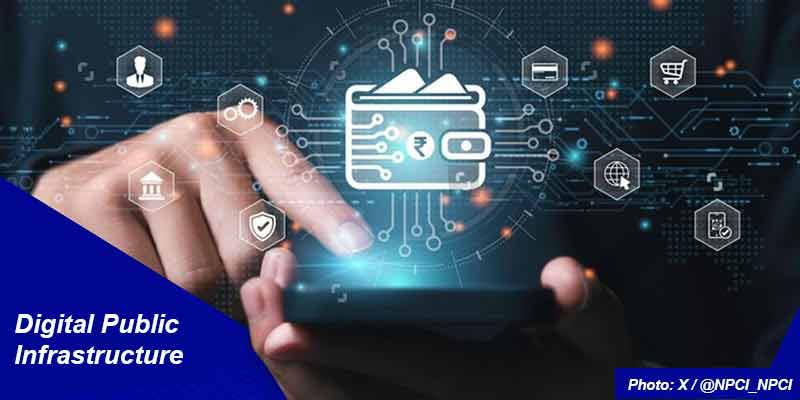
• The government of India has signed agreements with 23 countries for sharing or cooperation on Digital Public Infrastructure (DPI), commonly known as India Stack.
• These agreements focus on cooperation in areas such as digital identity, digital payments, data exchange and service delivery platforms, aligned with India’s broader DPI diplomacy under the India Stack framework.
• Unified Payments Interface (UPI) is now live in over eight countries, including the UAE, Singapore, Bhutan, Nepal, Sri Lanka, France, Mauritius and Qatar, positioning India as a global leader in digital payments.
• Its growing international adoption is boosting remittances, promoting financial inclusion, and strengthening India's position in the global fintech landscape.
• MoUs have been signed with Cuba, Kenya, United Arab Emirates and Lao People’s Democratic Republic (LPDR) for DigiLocker.
Digital Public Infrastructure (DPI)
• Digital Public Infrastructure (DPI) refers to platforms such as identification, payment and data exchange systems that help countries deliver vital services to their people.
• The DPI is an approach designed to solve multi-faceted complex societal problems that ultimately require both public and private participation and innovation.
• It allows nations to fast-track their economic development in an inclusive and competitive manner, leveraging cutting-edge technology, good governance and markets to drive outcomes such as health and financial inclusion, human development, access to jobs and employment, and improved public services.
• DPI drives innovation, competition and inclusion, and is governed by enabling rules and relies on a technology layer, governance framework and a multistakeholder ecosystem.
• Verifiable identity, electronic KYC, interoperable fast payments networks, and consented data sharing frameworks that offer open, interoperable solutions to societal problems at the population scale are strong examples of DPI.
• India has built DPI across several sectors including foundational identity, payments, consented data sharing, education, health, commerce, etc.
• Further, with the appropriate application of emerging technologies, including artificial intelligence (AI), the impact of DPI can easily be amplified further.
• It is also important to continuously focus on building new DPI and increasing adoption by incorporating feedback and encouraging innovation as and when possible.
Brief details of key DPI and digital solutions:
• Aadhaar – A biometric-based digital identity platform that enables unique identification and authentication of residents for efficient service delivery.
• Unified Payments Interface (UPI) – A real-time digital payment system enabling instant, interoperable, and secure person-to-person and merchant transactions.
• CoWIN – A digital platform for end-to-end management of vaccination services, including registration, scheduling, and certification.
• API Setu – A platform that enables secure and standardised sharing of government data and services through APIs.
• DigiLocker – A digital document wallet that allows citizens to store, access, and share authenticated electronic documents.
• Aarogya Setu – A digital health application providing risk assessment, health advisories, and access to health-related services.
• Government e-Marketplace (GeM) – An online platform for transparent and efficient procurement of goods and services by government entities.
• UMANG – A unified mobile and web platform providing single-window access to a wide range of government services.
• DIKSHA – A national digital platform supporting teachers and learners with e-content, training, and academic resources.
• e-Sanjeevani – A telemedicine platform enabling remote doctor-to-patient consultations, particularly in rural and underserved areas.
• e-Hospital – A hospital management system providing online registration, appointments, diagnostics, and billing services.
• e-Office – A digital platform for paperless governance enabling electronic file management and decision-making in government offices.
• eCourts – A mission-mode project for digitising court processes and improving access to judicial services.
• POSHAN Tracker – A mobile-based application for real-time monitoring of nutrition service delivery under ICDS.
• National Non-Communicable Diseases Platform (NCD) – A digital platform for screening, diagnosis, and management of major non-communicable diseases.
• Skill India Digital Hub (SIDH) – A unified digital platform integrating skilling, training, and employment-related services.
• Public Financial Management System (PFMS) – A platform for end-to-end monitoring of government funds and direct benefit transfers.
• PM GatiShakti – A GIS-based digital platform for integrated planning and coordinated implementation of infrastructure projects.
(The author is a trainer for Civil Services aspirants.)