
- India
- Feb 09
How can India position itself as a global leader in quantum technologies?
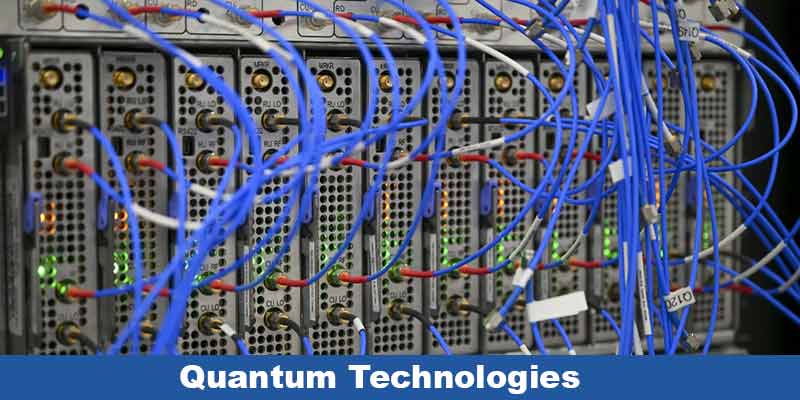
• Union Minister Jitendra Singh and Andhra Pradesh Chief Minister N. Chandrababu Naidu laid the foundation stone for the Amaravati Quantum Valley (AQV) at Uddandarayunipalem village on February 7.
• The event featured the unveiling of the foundation plaque, launch of the Amaravati Quantum Valley logo, launch of IBM and TCS Quantum Cloud Services, establishment of the IBM-TCS Quantum Innovation Centre, announcement of a Quantum Talent Hub, Quantum Reference Facility by SRM University, Quantum-Safe Applications initiative, and exchange of multiple MoUs with nine industry partners, marking a coordinated industry-academia-government partnership.
• These initiatives bring renewed national focus to the country’s ongoing efforts in quantum education and workforce development.
What are quantum technologies?
• Quantum technologies leverage the principles of quantum physics for breakthrough capabilities that go beyond classical systems.
• Quantum technology is based on the principles of quantum mechanics developed in the early 20th century to describe nature at the scale of atoms and elementary particles.
• Using quantum superposition, a set of unbreakable codes or super-speedy information processing, quantum computers are able to mimic several classical computers working in parallel.
• Quantum technology is manifested through applications in secure communication, disaster management through better prediction, computing, simulation, chemistry, healthcare, cryptography, imaging among others.
• Scientists have expanded quantum theory to understand biological phenomena such as smell, consciousness, enzyme catalysis, photosynthesis, avian navigation like that of the Robin, origin of life and effects on coronavirus.
• Some stalwarts in this field include Satyendra Nath Bose, Sir Chandrasekhara Venkata Raman and Meghnad Saha. India is currently at the forefront of tapping the second quantum revolution through massive investments in the field.
• The range of quantum technologies is expected to be one of the major technology disruptions that will change the entire paradigm of computation, communication and encryption.
• It is perceived that the countries who achieve an edge in this emerging field will have a greater advantage in garnering multifold economic growth and dominant leadership role.
• For India, quantum technology holds strategic importance in enhancing technology security & competitiveness and India’s position in the global technology landscape.
Quantum technologies include four major vectors:
1) Quantum Computing: It uses quantum bits or qubits and quantum information, promises computation that is exponentially faster than classical computing for certain problems such as simulating nature, optimisation, machine learning and factoring large numbers. At the same time, it could also be able to break RSA (Rivest–Shamir–Adleman) cryptography codes rendering much of the data and communications in today’s world vulnerable. Quantum advantage over classical computing is expected to be achieved in specific domains within this decade.
2) Quantum Communication: It uses quantum key distribution and entanglement, enables ultra secure communication that cannot be intercepted without detection. As quantum computing threatens to break existing cryptographic systems, quantum communication networks will become essential for safeguarding military, government, and critical infrastructure communications against even the most advanced adversaries. Quantum key distribution (QKD) has already been demonstrated in long-distance scenarios in multiple countries, including India, China and the US.
3) Quantum Sensing and Metrology: It uses quantum mechanical effects for highly sensitive measurements, e.g. atomic clocks and magnetometers. Such sensitive instrumentation will be critical for space, defence and aerospace applications, among others. Applications of quantum sensing are in active development and look plausible for strategic applications by 2035.
4) Quantum Materials: It leverages quantum mechanical properties for novel materials and devices that power and enable the other three vectors.
National Quantum Mission
• Globally, quantum remains at an early but rapidly advancing stage, fuelling a new international technology race.
• Governments and industry leaders in the US, China, Europe, and Asia have dramatically ramped up investments, with public funding alone surging past $10 billion annually in recent years.
• At stake is not just economic value, but national security, digital sovereignty, and future industrial competitiveness.
• Recognising the magnitude of this opportunity and risk, India launched the National Quantum Mission (NQM) in April 2023, allocating Rs 6,003.65 crore through 2030-31 to “seed, nurture, and scale up” domestic quantum R&D and position India as a leader in the global quantum ecosystem.
• The Mission spans 43 institutions across 17 states and 2 Union Territories, organised through four thematic hubs focusing on:
i) Quantum Computing
ii) Quantum Communication
iii) Quantum Sensing and Metrology
iv) Quantum Materials and Devices.
• The national objectives include developing quantum computers with up to 1,000 physical qubits within eight years, establishing secure ground-to-ground quantum communication networks, enabling long-distance quantum communication, and achieving inter-city quantum key distribution across 2,000 kilometres.
• While this is a critical first step, global momentum and the scale of the opportunity demand far greater ambition and urgency.
An example on the possible impacts of quantum technologies
• Imagine a future where a child in a remote village is diagnosed with a rare genetic disorder. While diagnosis through genomic sequencing is becoming increasingly feasible, designing personalised treatments remains complex and time-consuming.
• By 2035, India’s homegrown quantum computing platforms may help accelerate drug discovery by simulating molecular interactions between disease-relevant proteins, coded by the child’s genome, and thousands of therapeutic candidates.
• Instead of relying solely on expensive wet-lab screening, researchers could use quantum-enhanced algorithms to identify promising molecules, simulate their properties, and predict their efficacy, substantially reducing early-phase discovery timelines.
• Although clinical validation will still require years, these advances could pave the way for faster, more accessible precision medicine, even in rural healthcare settings.
• The medicine would be delivered via India’s health digital public infrastructure (DPI) and monitored using quantum-enhanced diagnostic sensors.
• The child receives life-saving treatment not in a top tier urban hospital, but in a digitally connected primary health center nearby.
• This is the kind of leap quantum technologies promise across healthcare, materials, climate science, finance, and more.
• The predictive power of quantum computers will not only accelerate innovation but also democratise it as the hardware matures and
becomes widely available — making precision healthcare, advanced materials, and secure digital infrastructure accessible to all.
Vision for India’s Quantum Economy in 2035
• In December 2025, NITI Aayog released a roadmap on transforming India into a leading quantum-powered economy.
Key points of the vision include:
i) Incubating at least 10 globally competitive quantum startups, each surpassing $100 million in revenue.
ii) Capturing over 50 per cent of the value in the global quantum software and services market by harnessing our software and engineering strength.
iii) Achieving meaningful, scaled deployment of quantum technologies — home-grown and global — in strategic sectors across India.
iv) Commanding critical positions in the global quantum supply chain for both hardware and software, creating strategic dependencies and value.
v) Becoming a source of foundational scientific breakthroughs, with world-class research and intellectual property creation in quantum science and engineering.
• To realise this vision, India must rapidly bridge current gaps through coordinated national action.
Key priorities would include:
i) Expand the Quantum Workforce: Grow the scientific, deep engineering and professional workforce that is deployment-ready by an order of magnitude in two to three years.
ii) Catalyse Industry Engagement and Investment: Significantly increase the awareness among industry leaders and in government sectors of the potential of quantum technology for their sector and stimulate much higher investment into quantum technologies in two to five years.
iii) Accelerate Lab-to-Market Transition: Significantly improve ease of doing research, of technology validation and of taking technology from lab-to-market, within two years.
iv) Grow Fundamental Science and Risk Appetite: Take steps to substantially grow quality and quantity of fundamental scientific research, while also growing risk appetite in our funding entities and research institutions in two to five years.
v) Lead in Global Standard Setting: Engage actively with global standards bodies and take leadership in international standard setting related to quantum technologies to ensure that Indian products have access to global markets.
vi) Strengthen Trade: Ensure strong trade relations and ease of technology export and import, especially in quantum related technology areas.
• Quantum technologies are still in their formative stages globally, offering India a rare opportunity to shape the trajectory of a foundational technology — unlike previous technological waves where India often had to play catch-up.
• This time, India can position itself as a global leader from the outset.
• Realising this potential, however, will require bold, coordinated, and immediate action:
i) Accelerating scientific research.
ii) Fostering rapid technology development.
iii) Scaling up workforce preparation.
iv) Enabling commercialisation at pace and scale.