
- India
- Feb 13
Govt clears procurement of 114 Rafale fighter jets for the Air Force
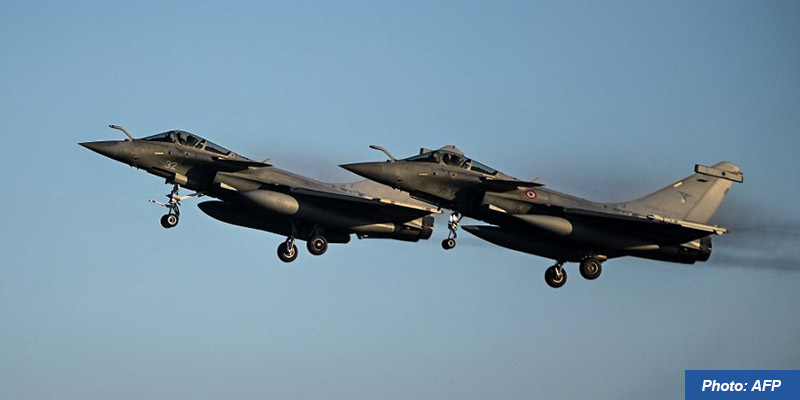
The Defence Acquisition Council, under the chairmanship of Defence Minister Rajnath Singh, accorded Acceptance of Necessity (AoN) for various proposals of the Services at an estimated value of about Rs 3.60 lakh crore on February 12.
What is the role of the Defence Acquisition Council?
• Pursuant to the recommendations made by the group of ministers on reforming the national security system in February 2001, a separate, dedicated structure for defence procurement was set up.
• In continuation of its efforts to streamline defence procurement procedures and to reduce timelines so as to ensure timely delivery of equipment to the armed forces, various measures to simplify the defence procurement procedure have been undertaken.
• A Defence Acquisition Council (DAC) was created as an overarching structure with the defence minister as its chairman.
• The DAC is the highest decision-making body of the defence ministry on procurement.
• The defence minister is the chairman of DAC. Its members include Chief of Defence Staff (CDS) and chiefs of Army, Navy and Air Force.
• The main objective of the DAC is to ensure expeditious procurement of the approved requirements of the armed forces in terms of capabilities sought and time frame prescribed by optimally utilizing the allocated budgetary resources.
Its functions include:
i) Give in principle approval of a 15 years Long Term Integrated Perspective Plan (LTIPP) for defence forces.
ii) Accord of acceptance of necessity to acquisition proposals.
iii) Categorisation of the acquisition proposals relating to ‘Buy’, ‘Buy & Make’ and ‘Make’.
iv) Look into issues relating to single vendor clearance.
v) Take decisions regarding ‘offset’ provisions in respect of acquisition proposals above Rs 300 crore.
vi) Take decisions regarding Transfer of Technology under the ‘Buy & Make’ category of acquisition proposals.
vii) Field trial evaluation.
What is inside the Rs 3.6 lakh crore military modernisation push?
• For the Indian Air Force (IAF), Acceptance of Necessity (AoN) was approved for the procurement of Rafale fighter jets, combat missiles and Air-Ship Based High Altitude Pseudo Satellite (AS-HAPS).
• The DAC cleared a proposal to procure 114 Rafale fighter jets under a government-to-government framework with France.
• The procurement of Rafale aircraft will enhance the capability of undertaking air dominance roles across the spectrum of conflict and significantly boost the deterrence capabilities of IAF with long range offensive strikes.
• The majority of the fighter jets to be procured will be manufactured in India.
• The IAF currently operates 36 Rafale jets.
• In 2025, the Indian Navy sealed a Rs 64,000 crore deal to procure 26 marine variants of the Rafale jet.
• The combat missiles will enhance the stand-off ground attack capability with deep strike power and very high accuracy.
• The AS-HAPS will be utilised towards carrying out persistent intelligence, surveillance and reconnaissance, electronic intelligence, telecommunication and remote sensing for military purposes.
• For the Indian Army, AoN was accorded for the procurement of Anti-Tank Mines (Vibhav) and overhaul of vehicle platforms of Armoured Recovery Vehicles (ARVs), T-72 Tanks and Infantry Combat Vehicles (BMP-II).
• Vibhav mines will be laid as anti-tank obstacle system to delay the advance of enemy mechanised forces.
• The overhaul of vehicle platforms of ARVs, T-72 Tanks and BMP-II will enhance service life of equipment ensuring readiness and operational effectiveness of the Indian Army.
• For the Indian Navy, AoN was cleared for 4 MW Marine Gas Turbine based Electric Power Generator and P8I Long Range Maritime Reconnaissance Aircraft.
• Induction of 4 MW Marine Gas Turbine based Electric Power Generator under Make-I category of Defence Acquisition Procedure 2020 will minimise the dependency on foreign manufacturers, ensure self-reliance in power generation requirement of Indian Navy.
• The acquisition of P8I aircraft will significantly boost the Navy’s combat/war-fighting capability of long-range anti-submarine warfare, maritime surveillance and maritime strike capability.
• For the Indian Coast Guard (ICG), AoN was accorded for the procurement of electro-optical/infrared system for Dornier aircraft. The procurement will assist in enhancing the efficacy of maritime surveillance capability of the ICG.
Key points on Rafale jets:
• Dassault Aviation is the French aerospace manufacturer of the Rafale aircraft, which is touted as an “omnirole” fighter.
• The Rafale entered service with the French Navy in 2004 and with the French Air Force in 2006.
• With its outstanding load-carrying capability and its advanced mission system, the Rafale can carry out air-to-ground strikes as well as air-to-air attacks and interceptions during the same sortie.
• The fully versatile Rafale is able to carry out all combat aviation missions: air superiority and air defence, close air support, in-depth strikes, reconnaissance, anti-ship strikes and nuclear deterrence.
The Rafale is available in three variants:
i) Rafale C single-seater operated from land bases.
ii) Rafale M single-seater for carrier operations.
iii) Rafale B two-seater flown from land bases.
• All three variants share a common airframe and a common mission system, the differences between naval and land versions being mainly limited to the undercarriage and to the arresting hook. and the ability to be a training aircraft for the Rafale B.
• The Rafale can reach almost twice the speed of sound with a top speed of 1.8 mach.