
- India
- Feb 17
- Sreesha V.M
President inaugurates centenary celebrations of Ol Chiki script
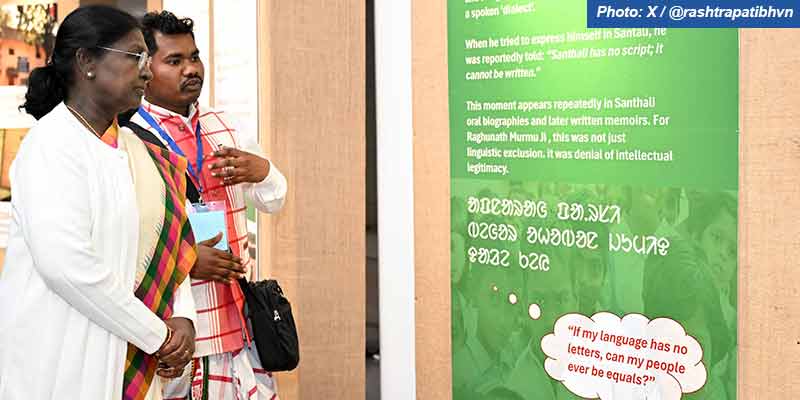
• President Droupadi Murmu inaugurated the centenary celebrations of the Ol Chiki script, being organised by the Ministry of Culture, in New Delhi on February 16.
• Ol Chiki is the official script of the Santhali language, one of India’s prominent tribal languages spoken widely across Jharkhand, Odisha, West Bengal, Assam, and Bihar.
• A special postage stamp and a commemorative Rs 100 coin, along with a souvenir on Ol Chikiscript, were also released at the event.
Creation of Ol Chiki Script
• Prior to the 20th century, Santhali was transcribed using various borrowed scripts, including Roman, Bangla, Odia and Devanagari.
• These scripts facilitated limited written expression, and hence they were not specifically designed to accurately represent the distinctive phonetic features of the Santhali language.
• The language includes unique sounds, such as glottal stops and specific vowel patterns, which was difficult to accurately represent using external writing systems.
• Consequently, this often led to distortions in pronunciation and meaning, thereby creating obstacles in educational contexts and hampering systematic linguistic development preservation.
• The absence of a standardised script posed significant challenges for documentation, formal education, and literary development.
• Ol Chiki was developed in 1925 by Pandit Raghunath Murmu to provide Santhali with a scientific and dedicated writing system.
Key linguistic features include:
i) Designed exclusively for Santhali.
ii) 30 letters representing vowels and consonants.
iii) Each symbol corresponds directly to a specific sound.
iv) Accurately captures glottal stops and unique phonetic elements.
v) Unlike adapted scripts, Ol Chiki provided a linguistically precise and culturally rooted medium of written expression.
• The introduction of Ol Chiki marked a turning point in the evolution of Santhali as a written language.
• By providing a script rooted in linguistic authenticity, it enabled the language to transition from an exclusively oral medium to a structured written form.
• The script made it possible to record vocabulary, grammar, and pronunciation with accuracy.
• It also facilitated the standardisation of language use, thereby supporting teaching, translation, and publication.
Who was Pandit Raghunath Murmu?
• Pandit Raghunath Murmu, a revered figure in the Santhali community, was born in 1905 in Dandbose village of Mayurbhanj district in Odisha.
• Deeply immersed in Santhali traditions from a young age, he was driven by the need to give his language a distinct written identity.
• This vision led to the creation of the Ol Chiki script.
• His dedication to cultural preservation and education earned him the honorary title of ‘Pandit’.
• He authored High Serena (1936), the first book in Ol Chiki.
• His contributions received wide recognition, including an honorary doctorate from Ranchi University and honours from the Odisha Sahitya Akademi.
Inclusion of Santhali in the Eighth Schedule
• In 2003, the Santhali language was formally included in the Eighth Schedule of the Constitution through the 92nd Constitutional Amendment Act.
• This recognition marked the transition of Santhali from a culturally rich but administratively marginalised language into one acknowledged within India’s formal linguistic framework.
• The inclusion enabled the language to receive institutional support in education, governance, and public communication, while also facilitating its use in competitive examinations, literary promotion, and academic research.
• This strengthened the adoption of the Ol Chiki script in formal domains such as school curricula and state-level publications.
• The Constitution of India was officially translated into the Santhali language using the Ol Chiki script and released in December 2025.
• Published by the Legislative Department, this marked the first time that the nation’s foundational legal text became available in Santhali in its own indigenous script.
(The author is a trainer for Civil Services aspirants.)