
- India
- Feb 17
What is black box or flight data recorder?
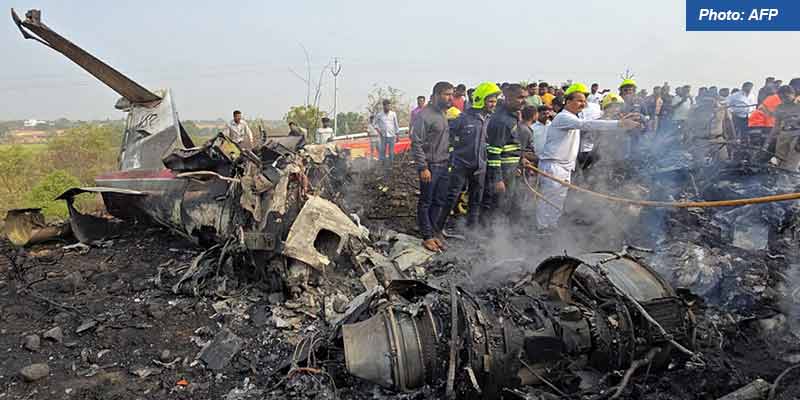
• The Aircraft Accident Investigation Bureau (AAIB) is carrying out a detailed investigation into the accident involving Learjet 45 aircraft VT-SSK at Baramati on January 28.
• Maharashtra Deputy Chief Minister Ajit Pawar and four others were killed in the fatal crash.
• The aircraft was equipped with two independent flight recorders.
• Both recorders were exposed to intense heat for a prolonged period during the accident and sustained fire damage.
• The Digital Flight Data Recorder (DFDR), manufactured by L3-Communications, has been successfully downloaded at the AAIB Flight Recorder Laboratory.
• The Cockpit Voice Recorder (CVR), manufactured by Honeywell, is undergoing detailed technical examination.
• The AAIB is diligently following all prescribed technical and procedural protocols to ensure a comprehensive, objective and evidence-based investigation.
What is black box in an aircraft?
• The black box stores all kinds of information and conversations about the plane.
• Aircrafts are usually equipped with two boxes that record information about a flight. Both recorders are installed to help reconstruct the events leading to an aircraft accident.
• One of these, the Cockpit Voice Recorder (CVR), records radio transmissions and sounds in the cockpit, such as the pilot’s voices and engine noises. The other, Flight Data Recorder (FDR), monitors parameters such as altitude, airspeed and heading. Both recorders are installed in the most crash survivable part of the aircraft, usually the tail section.
• They are not actually black, but high-visibility orange. Experts disagree about how the nickname originated, but it has become synonymous with the quest for answers after crashes. Many historians attribute their invention to Australian scientist David Warren in the 1950s.
What are the parts of a black box?
It weighs about 4.5 kg and contain four main elements:
i) A metal chassis designed to hold the recorder and facilitate recording and playback.
ii) An underwater locator beacon to assist in locating in the event of an overwater accident. The device called a “pinger” is activated when the recorder is immersed in water.
iii) The core housing or ‘Crash Survivable Memory Unit’, made of stainless steel or titanium, and designed to withstand equivalent to 3,400 times that of gravity.
iv) Inside that housing, circuit boards holding fingernail-sized recording chips.
• The Cockpit Voice Recorder records the flight crew’s voices as well as other sounds inside the cockpit. The recorder’s “cockpit area microphone” is usually located on the overhead instrument panel between the two pilots. Communications with Air Traffic Control, automated radio weather briefings and conversation between the pilots and ground or cabin crew are recorded.
• The Flight Data Recorder onboard the aircraft records many different operating conditions of the flight. It monitors many important parameters such as time, altitude, airspeed, heading and aircraft attitude. In addition, some FDRs can record the status of more than 1,000 other in-flight characteristics that can aid in the investigation. The items monitored can be anything from flap position to auto-pilot mode or even smoke alarms.
What is the role of AAIB?
• In accordance with Standards and Recommended Practices (SARPs) issued by the International Civil Aviation Organisation (ICAO) and to ensure independence of investigation from the regulatory function, the government of India decided to establish a bureau independent of Directorate General of Civil Aviation (DGCA).
• Keeping in mind the Indian scenario, the Aircraft (Investigation of Accidents and Incidents) Rules 2012 were formulated and notified on July 5, 2012.
• In accordance with these Rules and for the purposes of carrying out investigation into accidents, serious incidents and incidents, the government of India set up the Aircraft Accident Investigation Bureau (AAIB) in the Ministry of Civil Aviation on July 30, 2012.
• AAIB is an attached office of the Ministry of Civil Aviation.
• At present, investigation works are carried out as per amended Aircraft (Investigation of Accidents and Incidents) Rules 2017 as AAIB has got immediate and unrestricted access to all relevant evidence without seeking prior consent from judicial bodies or other government authorities.
• All accidents and serious incidents involving aircraft with all-up weight (AUW) more than 2,250 kg or turbojet aircraft are investigated by AAIB.
Functions of AAIB include:
• To facilitate the investigation and administrative work of the investigation whenever necessary.
• To formulate safety recommendations on the basis of safety studies, including induction of new technology to enhance safety, conducted from time to time.
• To establish and maintain an accident and serious incident database for effective analysis of information on actual or potential safety deficiencies.
• To forward the recommendations made in investigation reports and safety studies to DGCA and other regulatory authorities for their follow up and to obtain compliance of the same.
• To inform the International Civil Aviation Organisation (ICAO) of the issuance of a Safety Recommendation of Global Concern (SRGC) and its responses in dated transmittal correspondence, even when the SRGC is not addressed to ICAO.