
- India
- Feb 17
Who was Karpoori Thakur?
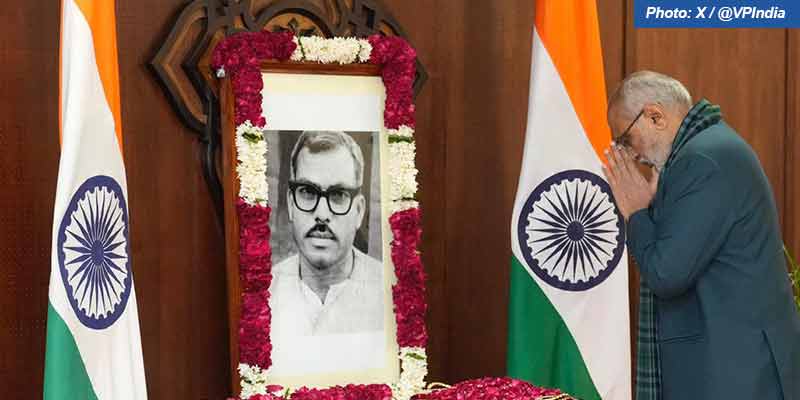
• Vice President C. P. Radhakrishnan paid floral tributes to Karpoori Thakur on his death anniversary at Uparashtrapati Bhavan in New Delhi on February 17.
• Thakur, who passed away in 1988, was the first non-Congress Socialist leader who became chief minister twice.
• In 2024, he was honoured with the Bharat Ratna posthumously.
• Thakur, known affectionately as ‘Jan Nayak’ (people’s leader), was the 49th recipient of the country’s highest civilian award.
Fountainhead of OBC politics in Bihar
• Born on January 24, 1924 in the village of Pitaunjhia, now known as Karpoori Gram in Samastipur district, Thakur is credited in Bihar politics for enforcing total prohibition of alcohol in 1970.
• Thakur abandoned college education for the Indian freedom struggle and was arrested between 1942 and 1945 for participating in the Quit India Movement.
• He was inspired by heavyweights like Ram Manohar Lohia who spearheaded the socialist movement in post-Independent India. He was also close to Jayaprakash Narayan.
• Although Thakur initially took up a teacher’s job in a village school, he had always been interested in politics and showed promise when he emerged victorious in the first state Assembly election held in 1952, from Tajpur constituency, as a candidate of the Socialist Party.
• The socialist leader rose to prominence in 1967, when the state saw its first non-Congress government headed by Mahamaya Prasad Sinha.
• Thakur, who became the deputy Chief Minister, also held the education portfolio, and is often remembered for doing away with English as a compulsory subject in schools.
• He became Chief Minister of Bihar for two terms — first for about six months in 1970 as the leader of the Socialist Party.
• Five years later, he returned as the Chief Minister for just short of two years between June 1977 and April 1979 as head of the Janata Party government.
• Thakur’s tenure as Chief Minister is best remembered for implementation of the recommendations of the Mungeri Lal Commission, whereby quotas for backward classes were introduced in the state.
• A highlight of the Mungeri Lal Commission was a separate sub-category called Most Backward Classes. The Most Backward Classes, now popular in political lexicon as ‘ati-pichhda’, were recognised as a distinct category during his time.
• This panel was a forerunner of the Mandal Commission, which ushered in quotas for OBCs at the national level in 1990.
• Thakur passed away in 1988.
• Being born in one of the most backward sections of society, Thakur was a leader whose political journey was marked by his unwavering commitment to the marginalised sections of society.
• He was a key figure in the struggle against social discrimination and inequality and his commitment to affirmative action gave representation and opportunities to the poor, oppressed, exploited and deprived sections of the country.
• During his career, his policies and reforms were pioneering in bringing about significant changes in the lives of many, especially in the fields of education, employment and farmer welfare.