
- India
- Feb 18
How are members elected to Rajya Sabha?
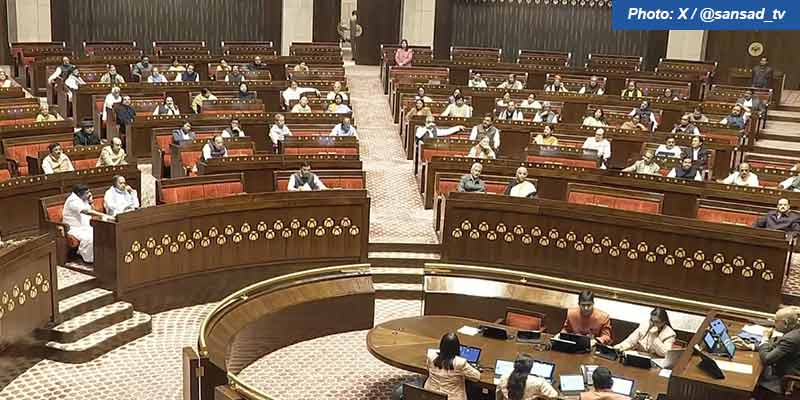
• Biennial polls to 37 Rajya Sabha seats across 10 states will be held on March 16, the Election Commission announced on February 18.
• The states where seats are falling vacant are Maharashtra (7 seats), Odisha (4 seats), Tamil Nadu (6 seats), West Bengal (5 seats), Assam (3 seats), Bihar (5 seats), Chhattisgarh (2 seats), Telangana (2 seats) and Himachal Pradesh (1 seat).
• These seats are falling vacant in April.
• The notifications for the polls will be issued on February 26.
Members of Rajya Sabha
• Article 80 of the Constitution lays down the maximum strength of Rajya Sabha as 250, out of which 12 members are nominated by the President and 238 are representatives of the states and also of the Union Territories of Delhi and Puducherry.
• The members nominated by the President are persons having special knowledge or practical experience in respect of such matters as literature, science, art and social service.
• At present, Rajya Sabha has 245 seats. Of these, 233 members represent the states and the Union Territories, and 12 members are nominated by the President.
• Rajya Sabha is a permanent House and is not subject to dissolution. However, one-third of members of Rajya Sabha retire after every second year.
• A member who is elected/nominated for a full term serves for a period of six years.
• Article 84 of the Constitution lays down the qualifications for membership of Parliament.
• The member should be a citizen of India above 30 years of age and possessing such other qualifications as may be prescribed by law of Parliament.
• The election held to fill a vacancy arising otherwise than by retirement of a member on the expiration of his term of office is called ‘bye-election’.
• Elections to the Rajya Sabha are indirect.
• Members of Rajya Sabha are elected by the elected members of the Assemblies of states and Union Territories in accordance with the system of proportional representation by means of the single transferable vote.
• While the nominated members of Rajya Sabha have a right to vote in the election of the Vice-President of India, they are not entitled to vote in the election of the President of India.
Number of Rajya Sabha seats from states/UTs:
1) Andhra Pradesh - 11
2) Arunachal Pradesh - 1
3) Assam - 7
4) Bihar - 16
5) Chhattisgarh - 5
6) Goa - 1
7) Gujarat - 11
8) Haryana - 5
9) Himachal Pradesh - 3
10) Jharkhand - 6
11) Karnataka - 12
12) Kerala - 9
13) Madhya Pradesh - 11
14) Maharashtra - 19
15) Manipur - 1
16) Meghalaya - 1
17) Mizoram - 1
18) Nagaland - 1
19) NCT Delhi (UT) - 3
20) Odisha - 10
21) Puducherry - 1
22) Punjab - 7
23) Rajasthan - 10
24) Sikkim - 1
25) Tamil Nadu - 18
26) Telangana - 7
27) Tripura - 1
28) Uttar Pradesh - 31
29) Uttarakhand - 3
30) Jammu & Kashmir (UT) - 4
31) West Bengal - 16
• In total, eight members are elected from the Union Territories (3 from Delhi, 1 from Puducherry and 4 from Jammu & Kashmir). Other Union Territories are not represented in Rajya Sabha.