
- India
- Feb 21
Eminent Bengali author Shankar dies at 92
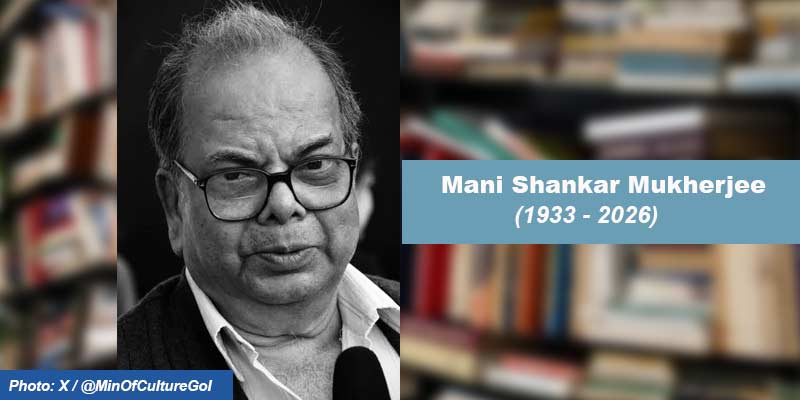
• Eminent Bengali writer Mani Shankar Mukherjee passed away on February 20. He was 92.
• He was popularly known as Shankar.
• The Sahitya Akademi award-winning writer is best known for his iconic novel ‘Chowringhee’.
• Born on December 7, 1933, in what is now Bangladesh’s Jessore district, Shankar grew up in Howrah after his family moved to Kolkata before World War II.
• The son of a lawyer, his early life was shaped by modest means and a restless curiosity about the human condition, traits that would later define his fiction.
• Before becoming a full-time writer, he worked as a clerk to Noel Barwell, the last English barrister practising at the Calcutta High Court.
• He wrote ‘Kato Ajanare’ (So Much Unknown), first serialised in Desh magazine in the 1950s.
• Later, ‘Chowringhee’ made him a household name.
• The novel was adapted into a blockbuster Bengali film starring Uttam Kumar and Subhendu Chatterjee in the lead in 1968. It was translated into multiple Indian and foreign languages, expanding Shankar’s readership far beyond Bengal.
• Two of his other major works, ‘Seemabaddha’ and ‘Jana Aranya’, formed part of Satyajit Ray’s acclaimed Calcutta trilogy.
• Another of his novels, ‘Man Samman’, was adapted into the Hindi film ‘Sheesha’ by Basu Chatterjee, while filmmakers like Ritwik Ghatak also attempted cinematic interpretations of his novel ‘Kato Ajanare’.
• Over time, Shankar became one of the rare Bengali authors whose fiction travelled seamlessly from page to screen.
• Shankar’s oeuvre was not limited to urban dramas. He wrote extensively for younger readers and produced bestselling memoirs that blended nostalgia with social commentary.
• His later works included deeply researched writings on Swami Vivekananda, notably exploring both the spiritual and human dimensions of his life.
• In 2021, he was conferred with the Sahitya Akademi Award for his autobiographical work ‘Eka Eka Ekashi’.
• His books have been translated into English, Hindi, Malayalam, Gujarati, French and Spanish, ensuring his voice reached readers across linguistic boundaries.