
- India
- Feb 21
- Sreesha V.M
Nadda launches Tetanus & Adult Diphtheria (Td) vaccine
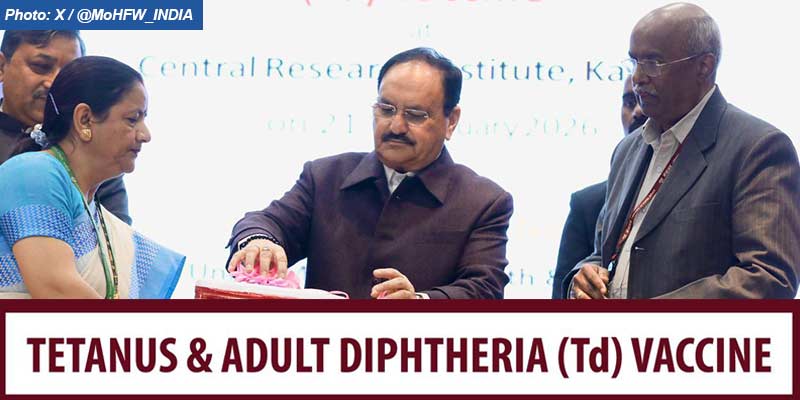
• Union Health Minister J.P. Nadda launched indigenously manufactured Tetanus and Adult Diphtheria (Td) vaccine at the Central Research Institute (CRI) in Kasauli, Himachal Pradesh on February 20.
Transition from TT vaccine to Td vaccine
• Tetanus (T) is a serious disease that causes painful muscle stiffness and spasms and can lead to severe health complications, including inability to open the mouth (lockjaw) and difficulty in swallowing and breathing, and may result in death.
• Diphtheria (D) is a potentially life-threatening infection that can cause breathing difficulties, heart failure, paralysis and death.
• Extensive scientific evidence indicates that widespread childhood immunisation with the DPT group of vaccines has significantly reduced the incidence of diphtheria and tetanus in many countries.
• However, antibody levels may decline over time, especially in the case of diphtheria, necessitating booster doses.
• In view of this, in 2006, the World Health Organisation (WHO) recommended that countries transition from the Tetanus Toxoid (TT) vaccine to the Td vaccine.
• This recommendation was reaffirmed in the WHO Tetanus Vaccine Position Paper (2017) and through deliberations of the Strategic Advisory Group of Experts (SAGE) in 2002 and 2016.
• The National Technical Advisory Group on Immunisation (NTAGI), Ministry of Health and Family Welfare, has also recommended replacing the TT vaccine with the Td vaccine in India’s immunisation programme for all age groups, including pregnant women.
• This transition aims to extend and strengthen protection against diphtheria in addition to tetanus, while sustaining the gains achieved in maternal and neonatal tetanus elimination and routine immunisation activities.
Td vaccine
• The Td vaccine (adsorbed, reduced D-Antigen content) protects against both tetanus and diphtheria.
• It is prepared by combining purified diphtheria toxoid and purified tetanus toxoid.
• The antigens are adsorbed into aluminium phosphate, which acts as an adjuvant, and thiomersal is added as a preservative.
• The introduction of the Td vaccine is aimed at strengthening protection among adolescents and adults and reducing morbidity and mortality associated with these vaccine-preventable diseases.
• The institute completed developmental studies, obtained a test licence, secured waivers for pre-clinical studies and phase I, II and III clinical trials, received marketing authorisation and licence for manufacture and sale, initiated commercial manufacturing, and obtained release from the Central Drugs Laboratory, Kasauli.
• The vaccine is now ready for launch and supply under the Universal Immunisation Programme (UIP).
• The Central Research Institute (CRI), functioning under the Directorate General of Health Services, Ministry of Health and Family Welfare, since 1905, plays a pivotal role in vaccine production in alignment with the National Vaccine Policy.
• The institute is engaged in the manufacture and supply of vaccines and antisera to meet the requirements of the UIP and other public health initiatives.
• The launch of the Td vaccine at the CRI is expected to augment domestic manufacturing capacity and ensure sustained availability of quality-assured vaccines under the National Immunisation Programme.
• The CRI will supply 55 lakh doses to the UIP by April this year.
• The supply is expected to increase progressively in subsequent years to further strengthen the UIP of the government of India.
Universal Immunisation Programme (UIP)
• The Universal Immunisation Programme (UIP) is one of India’s most comprehensive public health initiatives, aiming to provide life-saving vaccines to millions of newborns and pregnant women each year.
• Initially launched in 1978 as the Expanded Programme on Immunisation, it was rebranded as the UIP in 1985 when its coverage was extended beyond urban centres to rural areas, addressing disparities in healthcare access.
• In 1992, the UIP was incorporated into the Child Survival and Safe Motherhood Programme and later, in 1997, into the National Reproductive and Child Health Programme.
• Since 2005, under the National Rural Health Mission, the UIP has become a central component of India’s public health efforts, focusing on ensuring that vaccines reach every child, even in the most remote parts of the country.
• It targets 3.04 crore pregnant women and 2.7 crore newborns annually.
• More than 1.2 crore immunisation sessions are being conducted annually.
• Under UIP, immunisation is being provided free of cost against 12 vaccine preventable diseases: Nationally against 11 diseases — Diphtheria, Pertussis, Tetanus, Polio, Measles, Rubella, severe form of Childhood Tuberculosis, Rotavirus diarrhea, Hepatitis B, Meningitis & Pneumonia caused by Haemophilus Influenza type B and Pneumococcal Pneumonia and sub-nationally against Japanese Encephalitis (JE vaccine is provided only in endemic districts).
• The UIP has become one of the most cost-effective health interventions in the country, significantly reducing the under-5 mortality rate from 45 per 1,000 live births in 2014 to 32 per 1,000 live births (SRS 2020).
• Under this initiative, a child is considered fully immunised after receiving all vaccinations as per the national schedule within the first year of life.
• Nadda highlighted that due to systematic tracking and sustained immunisation efforts, vaccine coverage in the country has reached nearly 99 per cent.
• He described this as a transformative shift in India’s public health landscape, with institutions like CRI playing a pivotal role.
(The author is a trainer for Civil Services aspirants.)