
- India
- Feb 23
Govt launches access pass for fishing in Exclusive Economic Zone
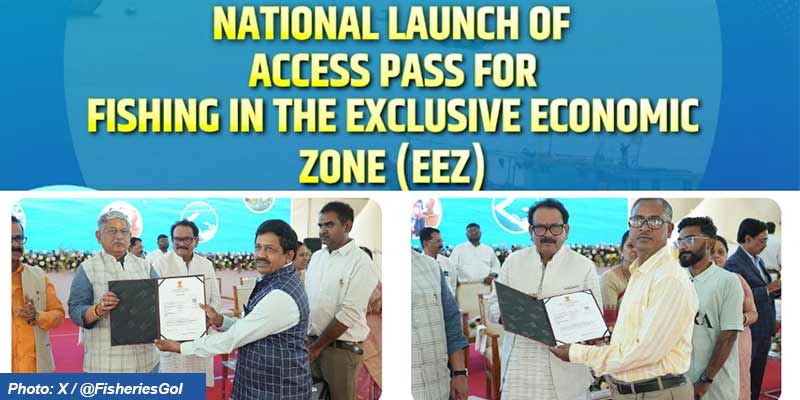
• Union Minister Rajiv Ranjan Singh launched the access pass for fishing in India’s Exclusive Economic Zone (EEZ) for all 13 coastal states and Union Territories on February 20.
• During the launch at an event in Gujarat’s Veraval, the minister handed over access passes to 37 fishermen representing 24 fisheries cooperative societies from all coastal states/UTs.
What is Exclusive Economic Zone?
• An Exclusive Economic Zone (EEZ) is a concept adopted at the Third United Nations Conference on the Law of the Sea (1982), whereby a coastal state assumes jurisdiction over the exploration and exploitation of marine resources in its adjacent section of the continental shelf, taken to be a band extending 200 nautical miles (370 km) from the shore.
• The coastal State has sovereign rights for the purposes of exploring and exploiting, conserving and managing natural living or non-living resources of the waters superjacent to the seabed and of the seabed and its subsoil.
• It also has rights with regard to other activities for the economic exploitation and exploration of the zone, such as the production of energy from the water, currents and winds.
• In the EEZ, the coastal State has jurisdiction with regard to the establishment and use of artificial islands, installations and structures, marine scientific research and protection and preservation of the marine environment.
• India is endowed with a vast and diverse marine resource base, supported by a coastline of approximately 11,099 km and an EEZ of about 24 lakh square kilometres.
• At present, most Indian fishing activity remains limited to 40-50 nautical miles from the coastline, while the vast EEZ, extending from 12 to 200 nautical miles remains significantly under-utilised, despite scientific assessments indicating substantial potential for high‑value oceanic resources, particularly tuna and tuna‑like species.
• The Andaman & Nicobar Islands and Lakshadweep together account for 49 per cent of India’s EEZ with an estimated marine fisheries potential of 2.48 lakh tonnes.
• While the territorial sea is a state subject, the EEZ is governed by the central government.
Access pass under the EEZ Rules
• The government of India announced in the Union Budget 2025-26 an enabling framework for the sustainable utilisation of fisheries resources in the EEZ and high seas.
• The government notified the Sustainable Harnessing of Fisheries in the Exclusive Economic Zone Rules, 2025, on November 4, 2025, under the Territorial Waters, Continental Shelf, Exclusive Economic Zone and Other Maritime Zones Act, 1976.
• The Rules constitute a landmark policy initiative aimed at promoting responsible and sustainable utilisation of marine fisheries resources in the EEZ, while ensuring conservation of marine ecosystems, compliance with international obligations and enhancement of fishers’ livelihoods.
• The access pass is a key instrument under the EEZ Rules to empower Indian fishers to sustainably harvest high-value oceanic resources.
It aims to:
i) Support the transition from near‑shore to deep‑sea fishing.
ii) Promote fisher organisation into cooperatives and Fish Farmer Producer Organisations (FFPOs).
iii) Enhance incomes through higher catch, better prices and export‑compliant practices such as traceability and certification.
• Under the EEZ Rules, an access pass is required for mechanised and large-sized motorised vessels, which can be obtained free of cost through the online Registration and Licensing of Fishing Craft (ReALCRaft) portal.
• The ReALCRaft portal, developed as a national online platform by the NIC and Department of Fisheries, provides web-based, citizen-centric services to marine fishers and coastal states/UTs for the registration and licensing of fishing vessels, transfer of ownership, and related processes, thereby promoting ease of doing business.
• ReALCRaft is also integrated with Marine Products Export Development Authority (MPEDA) and the Export Inspection Council (EIC) for issuance of fish catch and health certificates, which are key requirements for exporting seafood to premium international markets.
• This integrated digital system ensures end-to-end traceability, sanitary compliance, and eco-labelling, thereby enhancing the global competitiveness of Indian marine products.