
- India
- Feb 23
- Sreesha V.M
PM Modi dedicates Delhi-Meerut Namo Bharat Corridor to nation
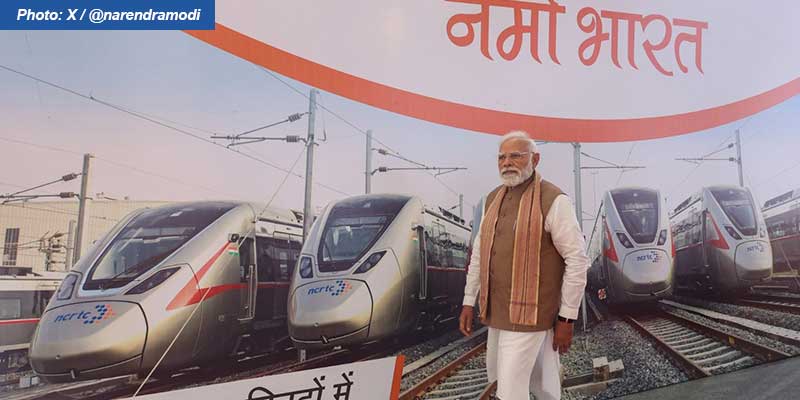
• Prime Minister Narendra Modi dedicated the entire Delhi-Meerut Namo Bharat Corridor to the nation from the Shatabdi Nagar station on February 22.
• The Delhi-Ghaziabad-Meerut RRTS Corridor passes through one of the most densely populated sections of the NCR.
• The 82-kilometer corridor will provide safe, reliable, and high-capacity commuter transit services between various locations along the corridor.
• Sarai Kale Khan station, the originating station of the corridor, is one of the four Namo Bharat stations commissioned with this inauguration.
• With a design speed of 180 km per hour, Namo Bharat is India’s first Regional Rapid Transit System.
• It will connect major urban centres such as Sahibabad, Ghaziabad, Modinagar and Meerut with Delhi at a faster pace.
• It is strategically located as a major multi-modal hub, seamlessly connecting Hazrat Nizamuddin railway station, Delhi Metro’s Pink Line, Veer Haqeeqat Rai ISBT, and the ring road.
Regional Rapid Transit System (RRTS)
• The National Capital Region (NCR) is among the world’s largest urban agglomerations and a major economic center of India.
• Rapid growth in vehicular traffic has made NCR one of the most polluted regions in the world. By 2030, NCR is projected to become the most populous urban agglomeration in the world, which will increase pressure on basic infrastructure such as housing, water supply, electricity and transport.
• The idea of a high-speed integrated commuter railway network to connect NCR was first mooted in 1998-99 in a study commissioned by Indian Railways.
• The Planning Commission formed a Task Force in 2005 to develop a multimodal transit system for NCR. This was included in the Integrated Transport Plan for NCR 2032 with special emphasis on Regional Rapid Transit System (RRTS) connecting regional centres.
• The Task Force identified eight corridors and prioritised three corridors namely Delhi-Meerut, Delhi-Panipat and Delhi-Alwar for implementation.
• The National Capital Region Planning Board (NCRPB) subsequently took up the study leading to signing of MoU and incorporation of NCRTC.
• The foundation stone for the Regional Rapid Transit System (RRTS) Delhi-Ghaziabad-Meerut Corridor was laid by Prime Minister Narendra Modi on March 8, 2019.
• The RRTS corridor is being built by the National Capital Region Transport Corporation (NCRTC), a joint venture company of the Centre with the governments of Delhi, Haryana, Rajasthan, and Uttar Pradesh.
• The Delhi-Meerut RRTS network is the first of three priority rail corridors in the country’s integrated transport network. The other two are Delhi-Alwar RRTS and Delhi-Panipat RRTS.
• The RRTS is a new rail-based, semi-high-speed, high-frequency commuter transit system with a design speed of 180 kmph, and operational speed potential of 160 kmph.
• RRTS is different from metro as it caters to passengers looking to travel a relatively longer distance with fewer stops and at higher speed.
• The objective of the project is to develop an efficient and sustainable regional transport system to reduce congestion in Delhi, by offering people the alternative of settling in surrounding cities and being able to commute to Delhi through a fast, reliable, safe and comfortable public transport system.
• RRTS will act as the transportation backbone for the region, while ensuring a balanced and sustainable urban development.
• The RRTS will use advanced, high technology signalling systems based on latest standards and will have multimodal hubs to ensure smooth interchange with other transport modes.
• The design of the stations consider the needs of the elderly, women, children, and differently abled.
• The Delhi-Ghaziabad-Meerut corridor is developed at a cost of more than Rs 30,000 crore.
(The author is a trainer for Civil Services aspirants.)