
- India
- Feb 23
- Sreesha V.M
India, Brazil set annual bilateral trade target of $30 billion by 2030
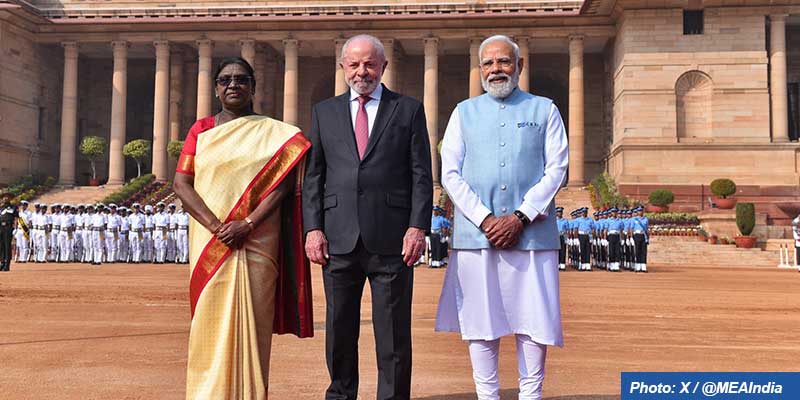
• Brazilian President Luiz Inacio Lula da Silva held a bilateral meeting with Prime Minister Narendra Modi in New Delhi on February 21.
• President Lula also participated in the AI Impact Summit.
• This was President Lula’s fifth visit to India and his second State Visit.
• He was accorded a traditional ceremonial welcome with guard of honour at the forecourt of Rashtrapati Bhawan.
• PM Modi and President Lula exchanged views on bilateral, regional and global issues of mutual interest, including cooperation in multilateral fora, the need to reform global governance and matters of importance to the Global South.
• They reiterated their decision to follow the strategic roadmap on five priority pillars for bilateral cooperation over the next decade:
i) Defence and security
ii) Food and nutritional security
iii) Energy transition and climate change
iv) Digital transformation and emerging technologies
v) Industrial partnerships in strategic areas.
• The leaders expressed satisfaction on the impressive growth of bilateral trade in 2025 registering an increase of 25.5 per cent over 2024.
Key outcomes of Modi-Lula meeting:
i) Joint declaration on digital partnership for the future: It is a new and strategic chapter of the bilateral relationship that embodies a shared vision for a digitally empowered future, to be built on mutual trust and collaborative progress. The partnership will encompass bilateral cooperation across a wide range of critical areas, including Digital Public Infrastructure (DPIs), through joint initiatives, institutions and projects drawing on the experience of the two countries. They concurred that DPIs are foundational enablers of inclusive, resilient and people-centered digital transformation. The leaders appreciated the launch of the Open Planetary Intelligence Network (OPIN).
ii) MoU on cooperation in the rare earths and critical minerals: The leaders welcomed the signing of the MoU on cooperation in rare earth elements and critical minerals and hoped that this would give an impetus to the bilateral cooperation, thus strengthening the supply value chains and global competitiveness in mineral exploration, mining, processing, recycling and refining of critical minerals.
iii) MoU on postal services: The agreement establishes a comprehensive framework for cooperation between the Department of Posts, India, and the Ministry of Communications, Brazil, aimed at enhancing strategic partnership and knowledge exchange in the postal domain.
iv) MoU on electronic certificates of origin: The MoU on the Mutual Recognition of Electronic Certificates of Origin (e-CoO) will enable the secure and immediate validation of electronic signatures, increasing agility, transparency, reliability, and legal certainty in origin verification procedures, while reflecting both countries’ shared commitment to administrative modernisation, harmonisation of practices, and convergence with international standards, thereby contributing to more efficient, predictable, and resilient trade flows.
v) Cooperation agreement for access to the Traditional Knowledge Digital Library (TKDL): The Brazilian Intellectual Property Office (INPI) will be granted access to the Traditional Knowledge Digital Library (TKDL) of India, a database kept by the Council for Scientific and Industrial Research (CSIR) which aims to prevent the misappropriation of traditional knowledge as intellectual property assets.
vi) MoU for cooperation in Micro, Small and Medium Enterprises (MSMEs), entrepreneurship and handicrafts.
vii) MoU in the field of mining for the steel supply chain.
viii) MoU between Brazilian Health Regulatory Agency (Anvisa) and Central Drugs Standard Control Organisation (CDSCO).
ix) MoU between the Ministry of Education and the International Institute of Information Technology Bangalore (IIIT-Bangalore), on Digital Transformation in Education.
x) MoU between Federal University of Minas Gerais, Brazil and Indian Institute of Mass Communication, India.
xi) MoU between Satyajit Ray Film and Television Institute (SRFTI) and the School of Communication and Arts of the University of Sao Paulo (ECA-USP).
(The author is a trainer for Civil Services aspirants.)