
- India
- Feb 24
President unveils bust of Rajagopalachari at Rashtrapati Bhavan
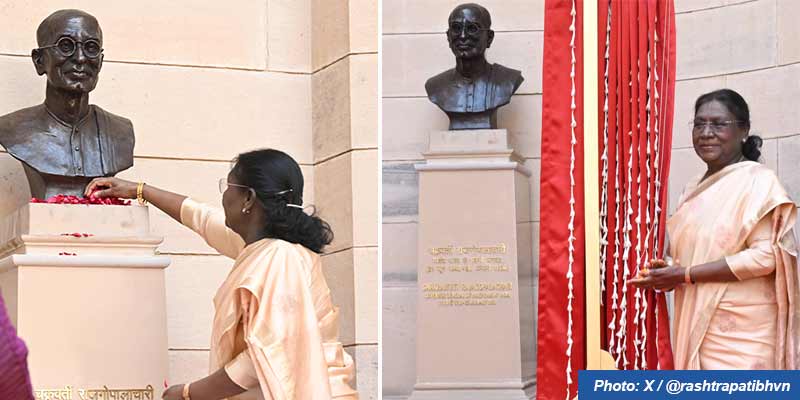
• President Droupadi Murmu unveiled Chakravarti Rajagopalachari’s bust at the Rashtrapati Bhavan on February 23.
• Rajagopalachari was the first and only Indian Governor-General of independent India.
• The bust of Rajagopalachari, at the Grand Open Staircase near Ashok Mandap opposite to the statue of Mahatma Gandhi, replaces the bust of British architect Edwin Lutyens.
• This initiative is part of a series of steps being taken towards shedding the vestiges of the colonial mindset and embracing, with pride, the richness of India’s culture, heritage, and timeless traditions.
• After the unveiling event, the President graced Rajaji Utsav at Rashtrapati Bhavan Cultural Centre (RBCC) where she took a round of the photo and book exhibition on Rajagopalachari's life and work.
Who was C. Rajagopalachari?
• Chakravarti Rajagopalachari, endearingly called ‘Rajaji’ by his admirers, was born on December 10, 1878 in Thorappalli village in Salem district of Madras Province (now part of Krishnagiri district, Tamil Nadu).
• He graduated from the Central Hindu College, Bangalore and joined the Law College in Madras city.
• In 1899, having passed the Bachelor of Law examination, he started practice at Salem.
• Endowed with superb articulation and a unique skill, he soon established himself as one of the most brilliant lawyers of Salem.
• Rajagopalachari was influenced by the call of Lokmanya Bal Gangadhar Tilak which exhorted every Indian to fight for complete freedom from the British Rule.
• Rajagopalachari enlisted himself as a member of the Indian National Congress.
• In July 1917, Rajagopalachari was nominated as the chairman of the Salem Municipality.
• On March 12, 1930, Gandhiji planned to set out on his historic Dandi March. In the Madras Province, Rajagopalachari led the long march to the sea coast to break the Salt Law. He was arrested and sentenced to six months imprisonment.
• On July 14, 1937, Rajagopalachari assumed the office of the Prime Minister of the then Madras Province.
• Eager to raise the standard of living of the Dalits, who mostly formed the agricultural labour, Rajagopalachari sought the abolition of ‘Zamindari’.
• After Independence, Rajagopalachari was appointed the Governor of West Bengal.
• In 1947, when the term of Lord Mountbatten, the first Governor-General of Independent India, ended, Chakravarti Rajagopalachari was chosen to take his place.
• He moved round the country, met people, heard their problems and tried to resolve them through the normal channels of administration.
• After the death of Sardar Patel in December 1950, Rajagopalachari was appointed the Home Minister.
• He piloted the Preventive Detention Act in Parliament which invited critical comments from the opposition.
• His advice was sought with regard to the preparation of the First Five Year Plan, handling of the delicate Kashmir question and in making preparations for the first national elections under the new Constitution.
• In December 1951, he resigned from the Central Cabinet.
• In recognition of his commendable service to the nation, Rajagopalachari was awarded ‘Bharat Ratna’ in 1954. He was the first to receive this highest civilian award.
• Rajaji formed Swatantra Party in 1959 which actively campaigned for a market economy. Swatantra Party, according to Rajaji, was less of a political party and more of a movement.
• He passed away on December 25, 1972 at the age of 93.