
- India
- Feb 27
- Sreesha V.M
India, Israel elevate ties to ‘Special Strategic Partnership’
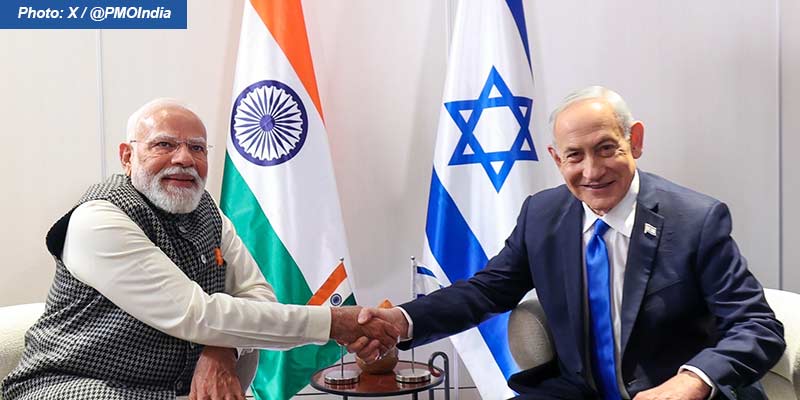
• Prime Minister Narendra Modi held official talks with his Israeli counterpart Benjamin Netanyahu in Jerusalem on February 26.
• Reflecting the deep trust and friendship between the two countries, the leaders decided to elevate the bilateral relationship to a ‘Special Strategic Partnership for Peace, Innovation and Prosperity’.
• Both leaders called for early conclusion of the proposed free trade agreement (FTA).
• PM Modi conveyed his support for the Gaza Peace Plan and hoped that the initiative would bring peace and stability to the region.
• Following the talks, several agreements and Memoranda of Understanding were exchanged.
• PM Modi also called on President Isaac Herzog in Jerusalem.
• PM Modi, along with President Herzog and the First Lady, planted a tree in the President’s garden under the ‘Ek Ped Maa Ke Naam’ (One Tree for Mother) initiative.
Key outcomes of PM Modi's visit:
Recognising the strategic partnership and advocating the need to comprehensively enhance bilateral relations, the PMs welcomed the signing of the following new agreements:
1) MoU on cooperation in AI: The MoU promotes collaboration in AI development and capacity building, supporting ethical AI, applications in civilian sectors, academic research, and public–private partnerships for sustainable growth.
2) MoU on the Cooperation in advancing education through the use of AI: The cooperation focuses on developing AI-powered, human-centered learning — covering innovative pedagogy, teacher development, regulatory frameworks, equitable AI access, research exchange, and integrating AI and data literacy for inclusive, future-ready education.
3) Letter of Intent on establishment of India-Israel Cyber Centre of Excellence in India: It establishes a joint Cyber Centre of Excellence in India to showcase cybersecurity best practices, emerging technologies, and digital resilience, fostering collaboration among government, industry, and academia.
3) MoU on the cooperation in advancing education through the use of AI: The cooperation focuses on developing AI-powered, human-centered learning — covering innovative pedagogy, teacher development, regulatory frameworks, equitable AI access, research exchange, and integrating AI and data literacy for inclusive, future-ready education.
4) Cultural Exchange Programme for the period 2026-2029: It fosters India-Israel cultural ties through exchanges in music, theatre, visual arts, dance, and other creative fields via festivals, workshops, and expert visits, deepening mutual understanding.
5) MoU between ICAR and MASHAV on establishment of the India-Israel Innovation Centre for Agriculture (IINCA): The MoU establishes a joint innovation centre at ICAR to develop next-generation agricultural technologies — such as precision farming, satellite-based irrigation, advanced machinery, and integrated pest management — and support germplasm exchange, demonstrations, post-harvest solutions, and capacity-building.
6) MoU on co-operation in the field of geophysical exploration: The MoU enhances India-Israel cooperation in mineral exploration using advanced geophysical and AI technologies, promoting data sharing, investment, and sustainable resource development.
7) MoU for development of National Maritime Heritage Complex (NMHC), Lothal in Gujarat: The MoU promotes India-Israel collaboration to celebrate shared maritime heritage through exhibitions, research, publications, and expertise exchange, supporting the National Maritime Heritage Complex and wider public engagement.
8) Declaration of Intent on cooperation in the field of horizon scanning: The DoI fosters India-Israel collaboration in advanced horizon scanning to strengthen strategic foresight, risk assessment, and technology planning through joint research, capacity building and AI-driven tools.
9) MoU on Cooperation in the field of fisheries and aquaculture: The MoU enhances India-Israel cooperation in sustainable, technology-driven fisheries and aquaculture — covering advanced systems, disease management, mariculture, and seaweed — through R&D, trade, training, innovation, and Centre of Excellence.
10) Presentation of report of the 4th India-Israel CEO Forum: The fourth CEOs Forum was held in Israel in November 2025 and a joint report was presented to the governments of both sides. The report provides insights and recommendations to align policies with industry trends, promote public-private collaboration, and support informed economic decision-making.
11) Implementation protocol on labour mobility in commerce and services sector: The protocol enables Indian workers to access employment in Israel through regulated channels across sectors like retail, cleaning, logistics, warehousing, food processing, hospitality, and recycling.
12) Implementation protocol on labour mobility in manufacturing sector: It covers recruitment across various manufacturing industries, including textiles, metals, electronics, chemicals, food processing, wood and paper, plastics, rubber, and other industrial sectors.
13) Implementation protocol on labour mobility in restaurant sector: It covers recruitment in restaurants, cafes, and other food preparation and sales businesses.
14) MoU between NPCI International (NIPL) and MASAV, Israel on implementation of UPI: The MoU aims to enable cross-border remittances between India and Israel via the Unified Payments Interface (UPI).
15) Agreement on cooperation between Israeli Institute of Commercial Arbitration (IICA) and Indian Council of Arbitration (ICA): The agreement promotes cooperation in arbitration and mediation through knowledge exchange, best practices, and joint training to strengthen expertise in both countries.
16) MoU between International Financial Services Centres Authority (IFSCA) and Israel Securities Authority (ISA): The authorities aim to advance cooperation in financial services through information exchange, best practices, fintech and regtech collaboration, and updates on key sector developments to foster an innovation-driven ecosystem.
17) MoU between Nalanda University and the Hebrew University of Jerusalem (HUJI): The MoU establishes a framework for faculty and student exchanges between the two universities in a range of disciplines, including Buddhist studies, archaeology, mathematics, and international relations.
18) Launch of the India-Israel Financial Dialogue to boost closer financial cooperation.
19) Both leaders agreed that up to 50,000 additional Indian workers may arrive in Israel within the next five years.
20) Establishment of the India-Israel Parliamentary Friendship Group in the Parliament of India.
(The author is a trainer for Civil Services aspirants.)