
- India
- Feb 28
- Sreesha V.M
CGA launches govt bank dashboard, govt bank manual
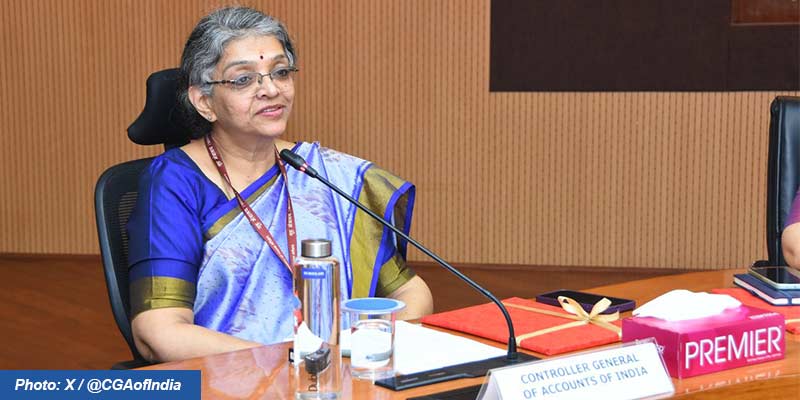
• The Controller General of Accounts T.C.A Kalyani launched government bank dashboard and government bank manual in New Delhi on February 27.
• The CGA highlighted that the reforms institutionalise uniform procedures and objective benchmarks, while reinforcing shared responsibility in safeguarding public funds.
Government Bank Manual
• The government bank manual provides a comprehensive and standardised framework for banks for handling government business.
• It clearly defines operational procedures, reporting obligations, reconciliation timelines, and compliance requirements.
• It aims to reduce ambiguity, mitigate operational risk, and strengthen accountability across all stakeholders.
Government Bank Dashboard
• The government bank dashboard introduces real-time, data-driven monitoring of critical banking functions wrt government business.
• It tracks key performance indicators such as remittance timelines, scroll compliance, reconciliation status, transaction success rates, and adherence to service-level standards.
• This represents a significant shift from reactive, post-facto corrections to proactive oversight and performance management.
• The next phase of reforms will focus on deeper digital integration, strengthened cybersecurity safeguards, advanced analytics capabilities, and institutional capacity building — further modernising the ecosystem of government banking operations.
Controller General of Accounts (CGA)
• The Controller General of Accounts (CGA), in the Department of Expenditure under the Ministry of Finance, is the principal adviser on accounting matters to the Union government and is responsible for preparation of the accounts and conduct of internal audits for the central government.
• The Office of CGA prepares monthly and annual analysis of expenditure, revenues, borrowings and various fiscal indicators for the Union government.
Difference between CAG and CGA
• Comptroller and Auditor General (CAG) is an authority, established by the Constitution of India under Chapter V. The CAG is appointed by the President.
• While CAG is an independent constitutional body, the Controller General of Accounts (CGA) works under the Ministry of Finance.
• The President lays down general principles of government accounting relating to Union / state governments and form of accounts on the advice of CAG. The CGA performs the function of maintaining them.
Functions of CGA
The Allocation of Business Rules, 1961 gives the duties and responsibilities of the CGA, as mentioned below:
i) General principles of government accounting relating to Union or state governments and form of accounts, and framing or revision of rules and manuals relating thereto.
ii) Reconciliation of cash balance of Union government with Reserve Bank in general and, in particular, of reserve deposits pertaining to civil ministries or departments.
iii) Overseeing the maintenance of adequate standards of accounting by Central Civil Accounts Offices.
iv) Consolidation of monthly accounts, preparation of review of trends of revenue realisation and significant features of expenditure, etc and preparation of annual accounts (including summary, civil appropriation accounts) showing under the respective heads, the annual receipts and disbursements for the purpose of the Union government.
v) Administration of Central Treasury Rules and Central Government Account (Receipt and Payment Rules 1983).
vi) Coordination and assistance in the introduction of management accounting system in civil ministries or departments.
vii) Cadre management of Group ‘A’ (Indian Civil Accounts Service) and Group ‘B’ Officers of the Central Civil Accounts Offices.
viii) Matters relating to the Central Civil Accounts staff belonging to Group ‘C’ and ‘D’.
ix) Disbursement of pension through Public Sector Banks (PSBs) in respect of central civil pensioners, freedom fighters, high court judges, former Presidents and MPs.
• A detailed analysis of the monthly trends of receipts, payments, deficit and its sources of financing are presented to the Union finance minister every month. The document has over a period of time evolved into an extremely useful tool for monitoring budgetary compliance and a handy reference for decision making.
• In consonance with the government’s policy towards transparency in public functioning, an abstract of the Union government accounts is also released every month through its website.
(The author is a trainer for Civil Services aspirants.)