
- India
- Feb 28
- Sreesha V.M
India celebrates National Science Day on February 28
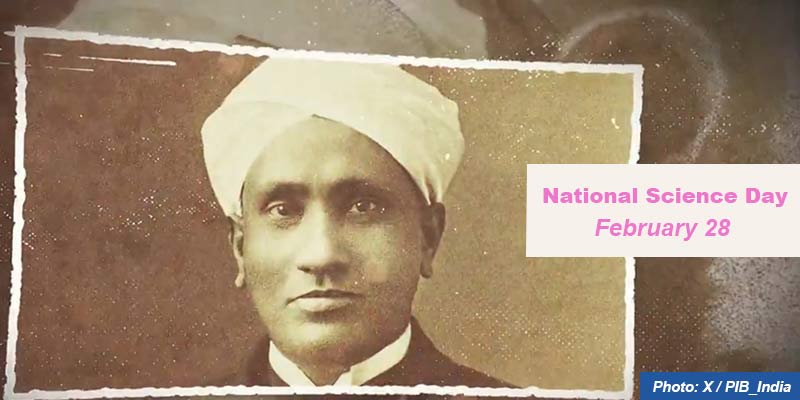
• National Science Day is celebrated annually on February 28 to commemorate Sir C.V. Raman’s discovery of the ‘Raman Effect’ (1928), which earned him the Nobel Prize in Physics in 1930.
• First observed in 1987, the day promotes scientific awareness, inquiry, and innovation across India.
• The theme for National Science Day 2026 is: ‘Women in Science: Catalyzing Viksit Bharat’.
Objectives of National Science Day:
• Promote scientific awareness in everyday life.
• Showcase India’s achievements in science and technology.
• Encourage innovation and technological development.
• Inspire youth to pursue careers in scientific research.
What is Raman Effect?
• The Raman Effect is a phenomenon in spectroscopy discovered by Chandrasekhara Venkata Raman while working in the laboratory of the Indian Association for the Cultivation of Science, Kolkata.
• When light meets particles that are smaller than the light’s wavelength, the light spreads in different directions.
• This occurs, for example, when light packets (photons) encounter molecules in a gas.
• Raman discovered that a small portion of the scattered light acquires other wavelengths than that of the original light.
• This is because some of the incoming photons’ energy can be transferred to a molecule, giving it a higher level of energy.
• Among other things, the phenomenon is used to analyse different types of material.
(The author is a trainer for Civil Services aspirants.)