
- India
- Mar 02
- Sreesha V.M
Kuno National Park receives nine cheetahs from Botswana
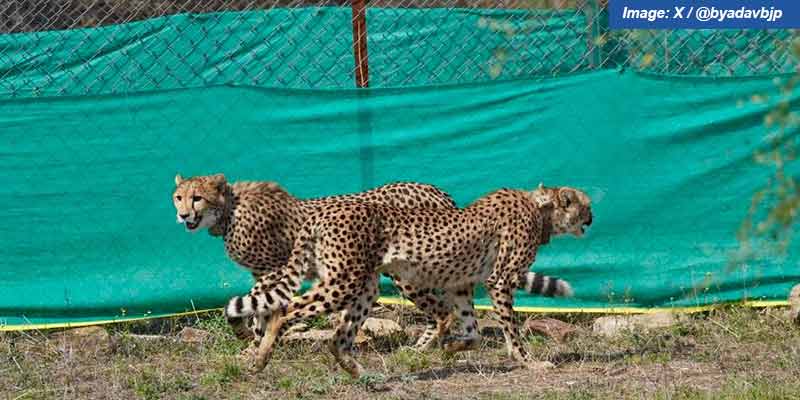
• Union Minister Bhupender Yadav released nine cheetahs received from Botswana into quarantine enclosures at Kuno National Park in Madhya Pradesh on February 28.
• The animals will undergo an acclimatisation and health monitoring phase before their gradual release into the larger landscape.
• This takes India’s total count of the big cats to 48.
How cheetahs from Botswana reached Kuno?
• In December 2024, the Indian government initiated formal discussions with the government of Botswana for sourcing cheetahs as part of Project Cheetah.
• To operationalise the partnership, an Indian delegation visited Botswana in September 2025.
• Following due scientific assessment, eight cheetahs were identified and captured from the Ghanzi region of Botswana.
• The cheetahs were subsequently transported approximately 700 kilometres by road to Gaborone under continuous veterinary supervision.
• In November 2025, during the visit of President Droupadi Murmu to Botswana, the eight cheetahs were formally handed over to the government of India.
• They were released into quarantine enclosures at Mokolodi Nature Reserve.
• On February 27, the cheetahs were transported from Mokolodi Nature Reserve to Gaborone Airport. With the support of the Indian Air Force, the animals were airlifted to Gwalior in a controlled and monitored environment.
• Upon arrival in India, the cheetahs were transferred by helicopter to Kuno National Park.
Cheetah Reintroduction Programme - Project Cheetah
• The ‘African Cheetah Introduction Project in India’ was first conceived in 2009. In 2013, the Supreme Court turned down the plea for relocation of African cheetahs at Kuno National Park in Madhya Pradesh.
• In January 2020, the Supreme Court allowed the government to introduce the African cheetah to a suitable habitat on an experimental basis to see whether it can adapt to Indian conditions.
• In September 2022, eight cheetahs airlifted from Namibia — five females and three males — were released in Madhya Pradesh’s Kuno National Park (KNP), putting the sanctuary in Sheopur district firmly on the world map.
• The cheetahs were introduced in KNP on September 17, 2022.
• It is said to be the world’s first inter-continental large wild carnivore translocation project.
• In a second such translocation, 12 cheetahs were flown in from South Africa and released into Kuno on February 18, 2023.
• In April 2025, two cheetahs were transported to Gandhi Sagar Sanctuary, located on the boundary of Mandsaur and Neemuch districts in Madhya Pradesh.
Significance of cheetah reintroduction
• Cheetah (Acinonyx jubatus), the world’s fastest land animal, got completely wiped out from India due to their use for coursing, sport hunting, overhunting and habitat loss.
• Cheetahs don’t need much water and can survive in dry forests, grasslands, open plains and desert regions.
• The last cheetah died in the country in 1947 in Korea district in present-day Chhattisgarh and the animal was officially declared extinct in 1952.
• Cheetah is considered vulnerable under the International Union for Conservation of Nature’s (IUCN) red list of threatened species, with a declining population of less than 7,000 found primarily in African savannas.
• The main goal of cheetah reintroduction project in India is to establish viable cheetah metapopulation in India that allows the cheetah to perform its functional role as a top predator and provides space for the expansion of the cheetah within its historical range thereby contributing to its global conservation efforts.
(The author is a trainer for Civil Services aspirants.)