
- India
- Mar 03
India, Canada to expand bilateral trade to Rs 4.65 lakh crore by 2030
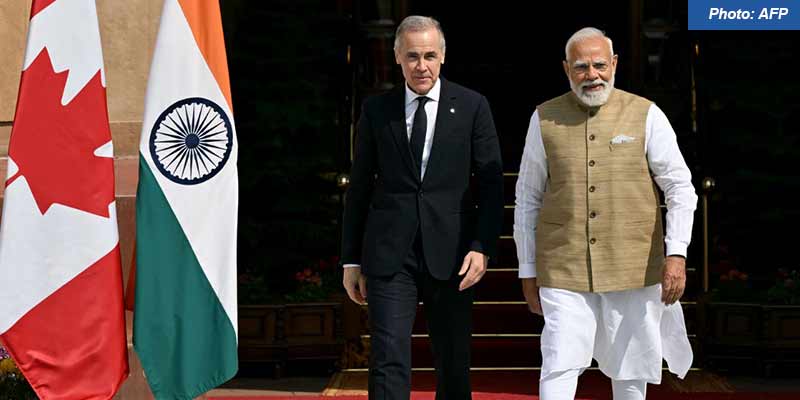
• India and Canada inked landmark pacts on supplies of Uranium and critical minerals during Canadian Prime Minister Mark Carney’s visit from February 27 to March 2.
• This was Carney’s first visit to India after taking over as the PM of Canada and is the first bilateral visit to India by a Canadian PM since 2018.
• Prime Minister Narendra Modi and his Canadian counterpart pledged to ramp up cooperation in defence, critical technologies, small and modular nuclear reactors, education, artificial intelligence and renewable energy.
Key outcomes of the meeting:
1) Terms of Reference for CEPA: The leaders reaffirmed their shared commitment to strengthening bilateral economic engagement through the resumption of discussions toward an ambitious and mutually beneficial Comprehensive Economic Partnership Agreement (CEPA). The leaders expressed confidence that a comprehensive trade framework would serve as a durable economic anchor for the partnership and support the shared aspiration of expanding bilateral trade to Rs 4.65 lakh crore by 2030. They welcomed the finalisation and signing of the Terms of Reference for CEPA negotiations and the launch of formal negotiations and expressed their shared commitment to conclude the talks by end-2026.
2) India-Canada-Australia trilateral MoU: Aims to advance trilateral cooperation in emerging technologies and innovation, under the Australia-Canada-India Technology and Innovation (ACITI) partnership.
3) Declaration of Intent on Joint Pulse Protein Centre of Excellence: Will establish a Canada-India Pulse Protein Centre of Excellence at National Institute of Food Technology, Entrepreneurship, and Management Kundli. It will strengthen food processing capabilities and nutrition-sensitive food systems through applied innovation. It will support advanced protein extraction and the development of fortified pulse products to address micronutrient deficiencies
4) Commercial contract for the supply of uranium ore concentrates: A CAD $2.6 billion commercial agreement between Cameco and the Department of Atomic Energy for the long-term supply of uranium. It will contribute towards India’s vision for its nuclear power program, under the Viksit Bharat initiative, to achieve 100 GW of nuclear power by 2047.
5) MoU between AICTE and Mitacs, Canada: It will expand the Globalink Research Internship program, enabling approximately 300 Indian undergraduate students annually to undertake research placements at Canadian universities. This initiative will strengthen institutional linkages, deepen academic collaboration across disciplines, and build future-ready skills through hands-on research and professional training.
6) MoU on critical minerals cooperation: This is a mutually beneficial collaboration between India and Canada to develop secure and resilient critical mineral supply and value chains. Entails promotion of investment and identification of projects in both countries and facilitating exchange of technical knowledge and best practices in critical and strategic mineral exploration, mining, beneficiation and processing for efficient extraction.
7) MoU on promoting the use of renewable energy: Promotes bilateral cooperation in the field of renewable energy. Supports exchange of information, best practices, lessons learned; and capacity building in the domain of energy storage, solar energy, wind energy, and biomass/bio-energy.
8) MoU on cultural cooperation: Carry out targeted cultural activities and cooperation projects with relevant cultural institutions in co-curated projects, performing arts, visual arts, other creative industries and emerging technology.
9) India-Canada Defence Dialogue: Both countries agree to institutionalising an India-Canada Defence Dialogue which will exchange views on respective defence policies, regional and global security developments, and strategic outlooks in order to identify opportunities for greater defence collaboration.
10) Canada to join International Solar Alliance: Enhanced collaboration through the International Solar Alliance will complement bilateral clean energy initiatives and contribute meaningfully to accelerating the global energy transition and achieving shared sustainability goals.