
- India
- Mar 06
- Sreesha V.M
India’s multi-pronged strategy to combat cervical cancer
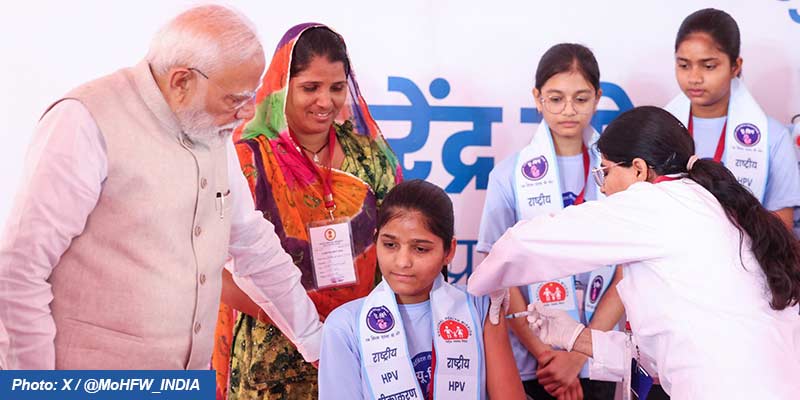
• Union Health Minister J.P. Nadda underlined India’s strong commitment to eliminating cervical cancer while stressing that the health and dignity of women remain a core national priority.
• Addressing a press briefing at the World Health Organisation (WHO) headquarters virtually, he highlighted that the government has adopted a multi-pronged approach focused on prevention, screening, early detection, and timely treatment.
• World Health Organisation (WHO) Director-General Tedros Ghebreyesus lauded the nationwide HPV vaccination campaign, describing it as the world’s largest free HPV vaccination drive.
• The WHO chief highlighted that more than 80,000 women lose their lives to cervical cancer in India every year, with around 42,000 new cases reported annually, underscoring the importance of preventive interventions such as HPV vaccination and early screening.
Major govt initiatives:
• Expansion of population-based screening programmes under the National Programme for Prevention and Control of Non-Communicable Diseases (NP-NCD), implemented as part of comprehensive primary healthcare services.
• Screening for cervical cancer using Visual Inspection with Acetic Acid (VIA) is now available at Ayushman Arogya Mandirs and various health facilities across the country for women between 30 and 65 years of age.
• Over 86 million women have already been screened for cervical cancer under the programme, reflecting India's sustained commitment to early detection and prevention.
• On February 28, Prime Minister Narendra Modi inaugurated the national Human Papillomavirus (HPV) vaccination campaign, targeting 12 million girls aged 14 years as a significant step toward safeguarding adolescent girls’ health and well-being.
• The campaign is being implemented over 90 days and follows a single-dose schedule using the Gardasil Quadrivalent vaccine, in accordance with recommendations of the World Health Organisation and India’s National Technical Advisory Group on Immunisation (NTAGI).
• The vaccine is being provided free of cost at designated government health facilities.
• Every vaccination event is recorded through the U-WIN digital immunisation platform, enabling real-time monitoring and accountability, while vaccine stocks and cold-chain logistics are tracked through the Electronic Vaccine Intelligence Network (eVIN) system.
• India fully endorses and actively supports the WHO Global Strategy to accelerate the elimination of cervical cancer.
90-70-90 targets by 2030
• WHO chief Tedros reiterated the importance of the WHO’s 90-70-90 global targets for 2030.
• To eliminate cervical cancer, all countries must reach and maintain an incidence rate of below 4 per 100,000 women.
• Achieving that goal rests on three key pillars and their corresponding targets:
i) Vaccination: 90 per cent of girls fully vaccinated with the HPV vaccine by the age of 15.
ii) Screening: 70 per cent of women screened using a high-performance test by the age of 35, and again by the age of 45.
iii) Treatment: 90 per cent of women with pre-cancer treated and 90 per cent of women with invasive cancer managed.
• Each country should meet the 90-70-90 targets by 2030 to get on the path to eliminate cervical cancer within the next century.
• India actively supports the WHO Global Strategy to accelerate the elimination of cervical cancer, including the 90-70-90 targets for 2030.
Some facts on HPV:
• Human papillomavirus (HPV) is a small, non-enveloped deoxyribonucleic acid (DNA) virus that infects skin or mucosal cells.
• HPV is a common sexually transmitted infection.
• It can affect the skin, genital area and throat.
• HPV usually goes away on its own without treatment. The immune system usually clears HPV from the body within a year or two with no lasting effects.
• Some HPV infections cause genital warts. Others can cause abnormal cells to develop, which go on to become cancer.
• At least 13 of more than 100 known HPV genotypes can cause cancer of the cervix and are associated with other anogenital cancers and cancers of the head and neck.
• The two most common ‘high-risk’ genotypes (HPV 16 and 18) cause approximately 70 per cent of all cervical cancers.
• Cancers from HPV can be prevented with vaccines.
• Currently, cervical cancer is the only HPV-caused cancer for which screening tests are available.
Key points on cervical cancer:
• Globally, cervical cancer is the fourth most common cancer in women.
• Cervical cancer develops in a woman’s cervix (the entrance to the uterus from the vagina).
• Cervical cancer starts in the cells of the cervix.
• The cervix connects the uterus to the vagina (birth canal).
• Cervical cancer usually develops slowly over time. Before cancer appears in the cervix, the cells of the cervix go through changes known as dysplasia, in which abnormal cells begin to appear in the cervical tissue. Over time, if not destroyed or removed, the abnormal cells may become cancer cells and start to grow and spread more deeply into the cervix and to surrounding areas.
• Almost all cervical cancer cases are linked to infection with high-risk human papillomaviruses (HPV).
• Effective primary (HPV vaccination) and secondary prevention approaches (screening for, and treating precancerous lesions) will prevent most cervical cancer cases.
• When diagnosed, cervical cancer is one of the most successfully treatable forms of cancer, as long as it is detected early and managed effectively.
• With a comprehensive approach to prevent, screen and treat, cervical cancer can be eliminated as a public health problem.
(The author is a trainer for Civil Services aspirants.)