
- India
- Mar 06
Ananda Bose resigns as West Bengal Governor
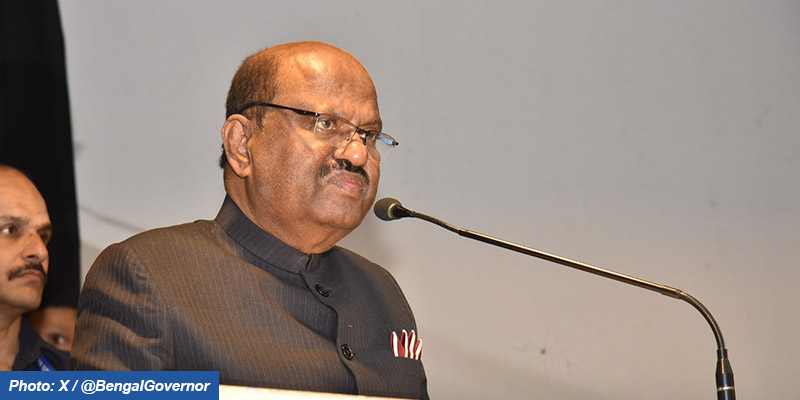
• C.V. Ananda Bose resigned as West Bengal Governor on March 5.
• President Murmu accepted Bose’s resignation.
• The President appointed Tamil Nadu Governor R.N. Ravi as the new Governor of West Bengal.
• Kerala Governor Rajendra Vishwanath Arlekar will discharge the functions of the Tamil Nadu Governor.
• The appointment was a part of a major reshuffle of gubernatorial posts effected in several states and Union Territories.
• Lt Gen Syed Ata Hasnain (retired) was appointed as the new Bihar Governor.
• Ladakh’s Lieutenant Governor Kavinder Gupta has been made the Governor of Himachal Pradesh.
• Hasnain succeeds Arif Mohammed Khan, who took oath as Bihar Governor on January 2, 2025.
• Former Indian ambassador to the US Taranjit Singh Sandhu has been appointed as Lieutenant Governor of Delhi.
• Lieutenant Governor of Delhi Vinai Kumar Saxena has been appointed as Lieutenant Governor of Ladakh.
• Lieutenant Governor of Ladakh Kavinder Gupta is appointed as Governor of Himachal Pradesh.
• Governor of Himachal Pradesh Shiv Pratap Shukla will be Telangana’s Governor.
• Governor of Telangana Jishnu Dev Varma has been appointed Maharashtra Governor.
• Gujarat Governor Acharya Devvrat was given the additional charge of Maharashtra in September 2025 after C.P. Radhakrishnan demitted office following his election as the country’s Vice President.
• Veteran BJP leader and former speaker of the Bihar Assembly Nand Kishore Yadav has been appointed as Nagaland Governor. Manipur Governor Ajay Kumar Bhalla has been holding additional charge as the Nagaland Governor.
• These appointments will take effect from the dates they assume charge of their respective offices.
Removal of Governor
• The Governor is appointed by the President which really means, by the Union Council of Ministers. The governor holds office during the pleasure of the President and there is no security of his/her tenure. He can be removed by the President at any time.
• Article 156 of the Constitution deals with the term of office of Governor.
It says that:
1) The Governor shall hold office during the pleasure of the President.
2) The Governor may, by writing under his hand addressed to the President, resign his office.
3) Subject to the foregoing provisions of this article, a Governor shall hold office for a term of five years from the date on which he enters upon his office.
The role of Governor
• The Governor is the chief executive of a state and his position is analogous to that of the President at the Centre. Despite being a nominal executive head (titular or constitutional head), the Governor has “a right to be consulted, to warn and encourage” and his role is overwhelmingly that of a “friend, philosopher and guide” to the council of ministers.
• Under this role, he also functions as a sentinel of the Constitution and a live link with the Union.
• The Constitution, under Article 153, provides for a Governor for each state. However, the Article was amended by the Seventh Constitutional Amendment (1956), which came as a result of the State Reorganisation Commission and currently, the same person may be appointed as Governor of two or more states.
• According to Article 154, the executive power of the state shall be vested in the Governor and shall be exercised by him either directly or through officers subordinate to him in accordance with this Constitution.
• Article 155 says that “the Governor of a state shall be appointed by the President by warrant under his hand and seal”.
• Article 156 provides that “the Governor shall hold office during the pleasure of the President”. A Governor shall hold office for a term of five years from the date on which he enters upon his/her office.
• The Governor may, by writing under his/her hand addressed to the President, resign his/her office.
• The only qualifications for appointment as Governor are that he/she should be a citizen of India and must have completed the age of 35 years.
• The Governor shall not be a member of the Legislature or Parliament; shall not hold any office of profit, shall be entitled to without payment of rent to the use of his official residences and shall also be entitled to such emoluments and allowances as may be determined by Parliament by law (Article 158).
• The Chief Minister is appointed by the Governor who also appoints other ministers on the advice of the Chief Minister (Article 164).
• The Governor appoints the Advocate General for the State (Article 165).
• Article 174 of the Constitution empowers the Governor to summon, prorogue or dissolve the House. Article 174(1) provides that the Governor shall from time to time summon the House to meet at such time and place as they think fit.