
- India
- Mar 10
CISF celebrates its 57th Raising Day
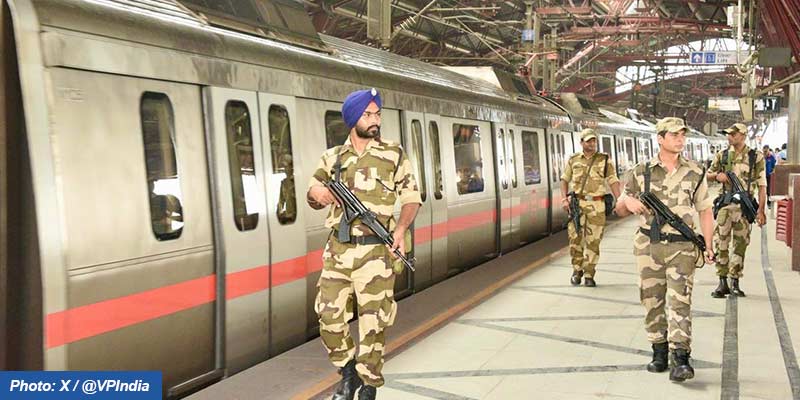
Prime Minister Narendra Modi greeted all personnel of the Central Industrial Security Force (CISF) on their 57th Raising Day on March 10.
What is the role of CISF?
• The Central Industrial Security Force (CISF) was raised through the Central Industrial Security Force Act, 1968.
• It came into force on March 10, 1969.
• The CISF was established with a strength of 3,129 personnel.
• The strength of the Force has grown into a formidable strength of 2.20 lakh personnel, deployed across almost all states.
• Additionally, it maintains 12 reserve battalions to respond to any security exigency and operates eight state-of-the-art training institutions across the country that continuously shape and strengthen the force.
• It is a part of Central Armed Police Forces (CAPFs) under the Ministry of Home Affairs.
Functions of CISF:
• The CISF is providing security cover to 361 critical national installations, including 71 domestic and international airports and fire protection cover to 115 industrial undertakings.
• It has become a premier multi-skilled security agency of the country, mandated to provide security to major critical infrastructure installations of the country in diverse regions including terrorist and naxal affected areas.
• CISF is currently providing security cover to atomic power plants, space installations, defence production units, mines, oil fields and refineries, major sea ports, heavy engineering/steel plants, fertilizer units, airports, hydro electric/thermal power plants, sensitive government buildings and heritage monuments (including Taj Mahal and Red Fort) and important private sector units.
• CISF is one of the largest Fire Protection Service providers in the country. It provides fire protection and fire safety coverage to 115 establishments. Fire wing is an integral part of CISF, managed by professionally trained personnel with science and engineering backgrounds. First fire wing unit was inducted at Fertilizer and Chemical Travancore (FACT), Kochi in 1970 with a sanctioned strength of 53 personnel. CISF is the only Central Armed Police Force having a full-fledged fire service wing.
• In 1999, CISF was authorised to extend technical and fire consultancy services on the payment basis to establishments even in the private sector where CISF is not deployed.
• The specialised task of airport security was assigned to CISF in 2000 following the hijack of Indian Airlines Flight IC-814 to Kandahar.
• The CISF was inducted in Delhi Metro Rail Corporation (DMRC) in 2007. DMRC is a Hyper Sensitive Unit and is the largest unit of CISF.
• CISF has been mandated to provide protection to the VIP protectees of various categories across the country. The VIP Security Wing of CISF, called Special Security Group (SSG), is looking after the security of VVIPs/VIPs.
CISF to oversee security of sea ports
• Union Home Minister Amit Shah has announced that the CISF will now oversee the security of various sea ports across the country.
• The announcement follows a decision by the Centre to designate the CISF as a Recognised Security Organisation (RSO) under the International Ship and Port Facility Security (ISPS) code, effectively making it the new safety regulator for approximately 250 facilities along India's maritime borders.
• This role was previously managed by the Indian Register of Shipping.
• The government identified a need for a professional paramilitary agency to handle core functions such as counter-terrorism and anti-sabotage operations at all export-import ports.
• Shah added that the CISF has been designated as the nodal agency for drone security.
• The Ministry of Home Affairs has decided to create a new vertical for this purpose.