
- India
- Mar 12
Former diplomat Taranjit Singh Sandhu sworn in as Delhi LG
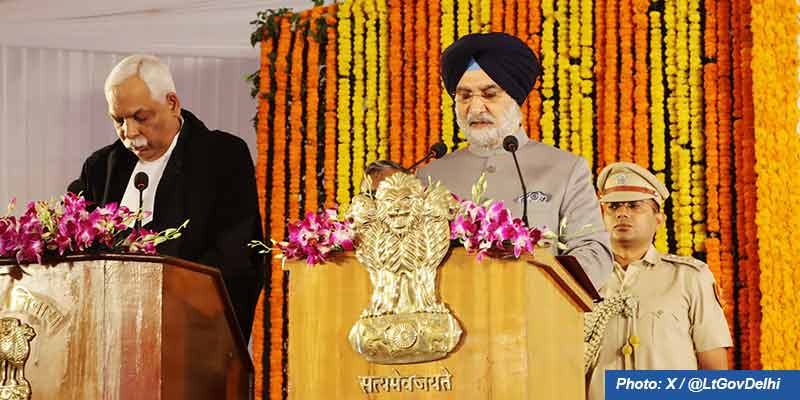
• Former diplomat Taranjit Singh Sandhu was sworn in as the 23rd Lieutenant Governor of Delhi in a ceremony held at Lok Niwas on March 11.
• Chief Justice of Delhi High Court Devendra Kumar Upadhyaya administered the oath of office and secrecy to Sandhu in the presence of Chief Minister Rekha Gupta and other dignitaries.
• Sandhu succeeds Vinai Kumar Saxena, who has been appointed as the Lieutenant Governor of Ladakh.
Who is Taranjit Singh Sandhu?
• A 1988-batch Indian Foreign Service officer, 63-year-old Sandhu is one of the most experienced Indian diplomats on United States affairs.
• Born on January 23, 1963 in a family of educationists, ambassador Sandhu studied at The Lawrence School, Sanawar and graduated with History Honors from St. Stephen’s College, Delhi. He pursued a master’s degree in international relations at the Jawaharlal Nehru University, New Delhi.
• He served in the Indian Mission in Washington, D.C., multiple times and was India’s ambassador to the United States from February 2020 to January 2024.
• He had also been at the Permanent Mission of India to the United Nations from July 2005 to February 2009.
• Sandhu contested the 2024 Lok Sabha elections on a BJP ticket from the Amritsar constituency in Punjab, and was unsuccessful.
Administration in Union Territories
There are eight Union Territories (UTs) in India.
1) Andaman and Nicobar Islands
2) Chandigarh
3) Dadra & Nagar Haveli and Daman & Diu
4) Lakshadweep
5) Jammu & Kashmir
6) Ladakh
7) Puducherry
8) National Capital Territory of Delhi.
• The Union Territories are specified in Part-II of the First Schedule to the Constitution of India.
• These territories are administered in accordance with the provisions of Article 239 to 241 of the Constitution of India.
• Every Union Territory is administered by an Administrator appointed by the President under Article 239 of the Constitution of India.
• Out of these eight Union Territories, NCT of Delhi, Puducherry and Jammu & Kashmir have legislatures and Council of Ministers while the rest of the UTs are without legislature.
• The Governor of Punjab is concurrently the Administrator of Chandigarh.
• In Delhi, Puducherry, Andaman & Nicobar Islands, Jammu & Kashmir and Ladakh the Administrators are designated as Lieutenant Governors.
• Under the Government of India (Allocation of Business) Rules 1961, ministry of home affairs is the nodal ministry for all matters of UTs relating to legislation, finance & budget, services and appointment of Lieutenant Governors and Administrators.
• The five UTs without legislature have the forum of Home Minister’s Advisory Committee (HMAC ) / Administrator’s advisory Committee (AAC). While HMAC is chaired by the Union Home Minister, AAC is chaired by the Administrator of the concerned UT.
• Members of Parliament and elected members from the local bodies (District Panchayats and Municipal Council) of the respective UTs are the members of these committees among others. The Committee discusses the general issues relating to social and economic development of the UTs.