
- India
- Mar 13
- Sreesha V.M
ISRO conducts sea level test of cryogenic engine at 22 tonne thrust
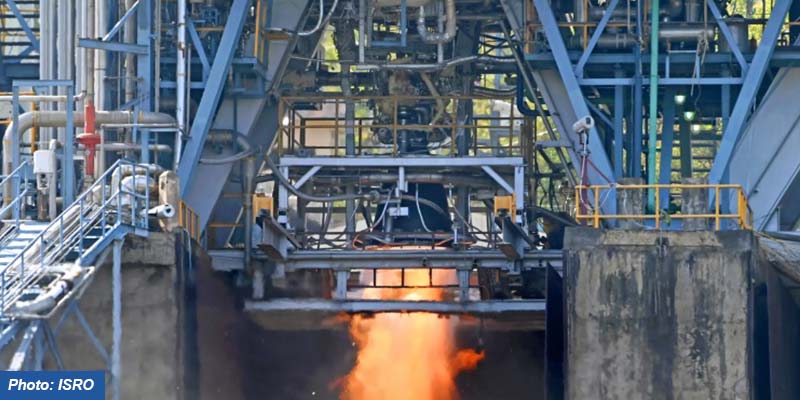
• ISRO successfully conducted a sea level hot test of its cryogenic engine (CE20) at 22 tonne thrust using nozzle protection system and multi-element igniter.
• The test was conducted at the ISRO Propulsion Complex in Mahendragiri, Tamil Nadu, where the engine operated for 165 seconds.
• The CE20 cryogenic engine powers the upper cryogenic stage of the Launch Vehicle Mark-3 (LVM3).
• In order to enhance the payload capability, future missions of LVM3 are planned to be operated with an uprated C32 stage with 22 tonne thrust for the CE20 engine.
• In view of this, the flight acceptance test of the CE20 engine also needs to be conducted at 22 tonne thrust level.
• Testing the CE20 engine at sea-level had considerable challenges primarily due to the high area ratio nozzle, which has an exit pressure of 50 mbar (millibar).
• A main concern during testing at sea-level include flow separation inside the nozzle, which leads to severe vibrations and thermal problems at the flow separation plane leading to possible mechanical damage of the nozzle.
• To solve this problem, ISRO developed and used a nozzle protection system.
• The CE20 engine has now completed a record 20 successful hot tests.
• The CE20 engine holds significance for India's upcoming Gaganyaan human spaceflight mission.
(The author is a trainer for Civil Services aspirants.)