
- India
- Mar 14
- Sreesha V.M
India exports GI-tagged Joha rice from Assam to UK, Italy
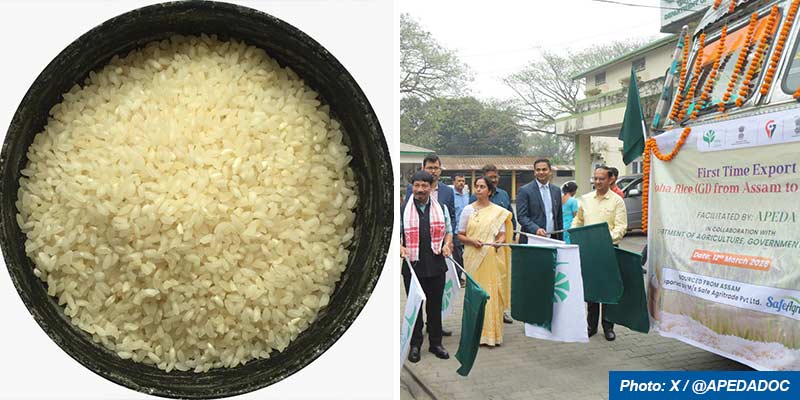
• The Agricultural and Processed Food Products Export Development Authority (APEDA) facilitated the export consignment of 25 metric tonnes of GI-tagged Joha rice from Assam to the United Kingdom and Italy.
• APEDA has been actively promoting the global presence of Joha rice.
• Earlier, it facilitated the export of 1 metric tonne of GI-tagged Joha rice to Vietnam and 2 metric tonnes to five Middle Eastern countries — Kuwait, Bahrain, Qatar, Oman and Saudi Arabia.
• This initiative is part of APEDA’s continued efforts to promote GI-tagged agricultural products from India and strengthen market linkages between producers and international buyers, while expanding agricultural exports from the northeastern region and ensuring better price realisation for farmers.
Key points on Joha rice:
• Joha rice, an indigenous aromatic variety from Assam, received the Geographical Indication (GI) tag in 2017.
• Known for its distinct fragrance, fine grain texture and rich taste, the rice is gaining recognition in premium domestic and international markets.
• In Assam, Joha rice is cultivated across about 21,662 hectares with an estimated production of approximately 43,298 metric tonnes during FY 2024-25.
• The major producing districts include Nagaon, Baksa, Goalpara, Sivasagar, Majuli, Chirang and Golaghat, providing strong potential for expanding exports while enhancing farmers’ income.
What is APEDA?
• The Agricultural and Processed Food Products Export Development Authority (APEDA) was established by the government under the Agricultural and Processed Food Products Export Development Authority Act passed by Parliament in December 1985. The Act came into effect on February 13, 1986.
• APEDA, which replaced the Processed Food Export Promotion Council (PFEPC), has its headquarters in New Delhi.
• It has 16 regional offices across India.
APEDA has been entrusted with the responsibility of export promotion and development of following scheduled products:
i) Fruits, Vegetables and their Products
ii) Meat and Meat Products
iii) Poultry and Poultry Products
iv) Dairy Products
v) Confectionery, Biscuits and Bakery Products
vi) Honey, Jaggery and Sugar Products
vii) Cocoa and its products, chocolates of all kinds
viii) Alcoholic and Non-Alcoholic Beverages
ix) Cereal and Cereal Products
x) Groundnuts, Peanuts and Walnuts
xi) Pickles, Papads and Chutneys
xii) Guar Gum
xiii) Floriculture and Floriculture Products
xiv) Herbal and Medicinal Plants
xv) De-oiled rice bran
xvi) Green pepper in brine
xvii) Cashew Nuts and its Products.
• In addition to this, APEDA has been entrusted with the responsibility to monitor the import of sugar as well.
• APEDA also functions as the Secretariat to the National Accreditation Board (NAB) for the implementation of accreditation of the Certification Bodies under National Programme for Organic Production (NPOP) for organic exports.
(The author is a trainer for Civil Services aspirants.)