
- India
- Mar 14
Govt revokes Sonam Wangchuk’s detention after almost six months
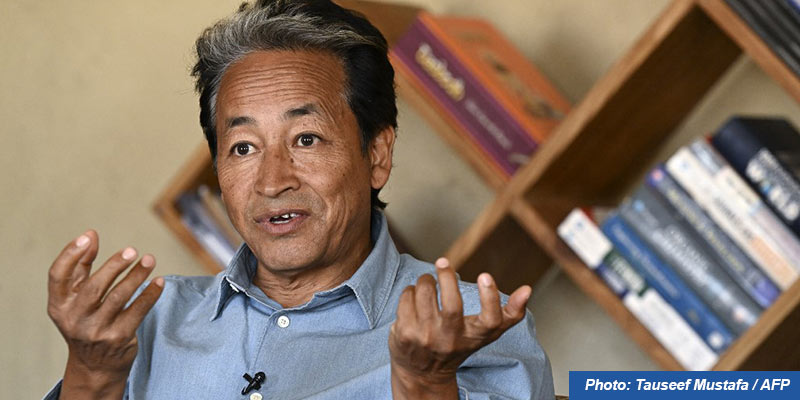
• The Centre revoked the detention of climate activist Sonam Wangchuk under the National Security Act (NSA) on March 14.
• Wangchuk was detained on September 26, 2025, two days after the protests over demands for statehood for Ladakh and its inclusion under the Sixth Schedule of the Constitution rocked Leh.
• Four protesters were killed and 90 others were injured in the clashes.
• He was detained under the National Security Act (NSA) on the orders of the Leh district magistrate to maintain public order and was later transferred to Jodhpur prison.
• Wangchuk has already undergone nearly half of the period of detention under the NSA.
Who is Sonam Wangchuk?
• A mechanical engineer by education, Wangchuk has been working in the field of education reform for more than 30 years.
• In 1988 he founded Students’ Educational and Cultural Movement of Ladakh (SECMOL), which aimed to bring reforms in the government school system in Ladakh.
• He was instrumental in the launch of ‘Operation New Hope’, a triangular collaboration of the government, village communities and the civil society to bring reforms in the government schools system.
• The programme involved formation of village education committees to take ownership of state schools, training of teachers in child friendly ways and re-writing and publishing localised text books for Ladakh.
• Wangchuk teaches innovation at the school, where together with the students he designed and built solar heated buildings that are low cost, made of earth and mud but maintain +15°C even when the outside temperature is -15°C in Ladakhi winters.
• In order to solve the water crisis facing mountain regions due to climate change and fast melting glaciers he also invented the Ice Stupa artificial glacier which stores the wasting stream waters in winter in the form of giant ice cones or stupas and releases the water in late spring when farmers need water.
What sparked deadly protests?
• The protest by the youth wing of the Leh Apex Body (LAB) demanding talks with the Centre on the extension of the Sixth Schedule and statehood for Leh and the Ladakh region turned violent on September 24.
• The Constitution’s Sixth Schedule, meant for the tribal population of the four northeast states of Tripura, Meghalaya, Mizoram and Assam, makes special provisions in terms of governance, powers of President and the Governor, type of local bodies, alternate judicial mechanisms and financial powers exercised through autonomous councils.
• On September 10, Wangchuk had begun a hunger strike in Leh.
• The fast was to push the Centre to resume dialogue in support of their four-point demand — statehood, extension of Sixth Schedule, separate Lok Sabha seats for Leh and Kargil and reservation for employment.
• The Ladakh Apex Body (LAB) youth wing called for the protest after two of the 15 people, who were on a hunger strike, were shifted to a hospital because their condition deteriorated on September 23.
• With the situation worsening rapidly, Wangchuk stepped in with an appeal and an announcement that he was cutting short the fast.
• The protests descended into violence, arson and street clashes.
National Security Act
• The National Security Act (NSA), 1980 provides for preventive detention in certain cases and empowers the central government and state governments to make orders for detaining certain persons if satisfied that such detention is necessary for preventing acts prejudicial to the defence of India, the security of India, the security of the State, the maintenance of public order or the maintenance of supplies and services essential to the community.
• It can also be invoked if a person is involved in smuggling activities, disrupting essential services, or promoting communal disharmony.
• The initial period of detention under the NSA is for up to 12 months.
• The detention can be extended for further periods, each not exceeding 12 months, with the approval of the government.