
- India
- Mar 15
EC announces election schedule for 4 states, Puducherry
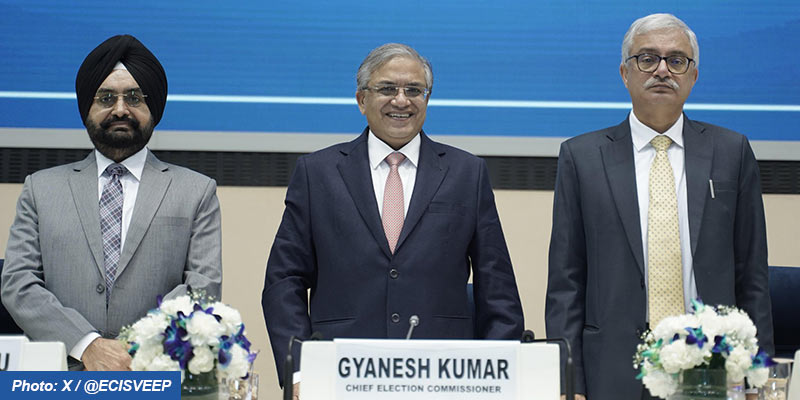
• The Election Commission of India announced the schedule for general elections to state Legislative Assemblies of Assam, Kerala, Tamil Nadu, West Bengal and Puducherry.
• The EC is mandated to conduct elections to the Legislative Assemblies before the cessation of their term, in exercise of the authority and powers conferred upon it under Article 324 read with Article 172(1) of the Constitution of India and Section 15 of the Representation of the People Act, 1951.
• There are 6.45 crore voters in West Bengal, 5.67 crore in Tamil Nadu, 2.71 crore in Kerala, 2.5 crore in Assam and 9.44 lakh in Puducherry.
Election schedule
• The elections will be held in a mix of single and multi-phase formats across the five states/UT.
• In Assam, polling will be held in one phase on April 9. There are 126 Assembly seats in Assam, and the BJP has been in power in the state since 2016. Himanta Biswa Sarma has been the Chief Minister since 2021.
• In Kerala, elections will also be conducted on April 9. Kerala has 140 seats and Left leader Pinarayi Vijayan has been the Chief Minister since 2016, leading the Left Democratic Front (LDF) government.
• The Union Territory of Puducherry will have polls on April 9. Puducherry Chief Minister N. Rangasamy has been in power since 2021. The UT has a total of 30 seats where polling will take place.
• In Tamil Nadu voting will be held on April 23. There are 234 Assembly seats in Tamil Nadu where DMK leader M.K. Stalin has been the Chief Minister since 2021.
• The elections in West Bengal will be conducted in two phases. Polling for 152 seats will take place on April 23, while the remaining 142 constituencies will vote on April 29. West Bengal has a total of 294 assembly seats with TMC leader Mamata Banerjee in power since 2011.
• The counting of votes will take place on May 4.
• There will be 2,18,807 polling stations in all four states and one UT — of which 31,486 booths are in Assam, 30,471 in Kerala, 75,032 in Tamil Nadu, 80,719 in West Bengal and 1,099 in Puducherry.
• The Model Code of Conduct has come into effect immediately with the announcement of the poll schedule.
Election Commission of India
• The Election Commission of India (EC) is a permanent independent constitutional body created under Article 324 of the Indian Constitution.
• The EC was set up on January 25, 1950, on the eve of India becoming a sovereign democratic republic with its headquarters in New Delhi.
Functions of EC
• EC is vested with the powers and responsibilities of superintendence, direction and control of the entire process of preparation and revision of electoral rolls for, and conduct of, elections to the houses of Parliament and Legislatures of the states and the Union Territories and of elections to the offices of President and Vice-President.
• It prepares, maintains and periodically updates (new registration, modification and deletion as per guidelines) the electoral rolls, registers political parties/candidates, supervises the whole process of conducting election, monitors the election campaigns, including funding and expenditure of candidates, maintaining Model Code of Conduct (MCC) to make the entire electoral process free fair democratic and accessible for all its stakeholders.
• It also facilitates coverage of the election process by the media, carries out the voter education and awareness measures, organises the polling stations/ booths where voting takes place, and oversees under stringent surveillance mechanisms the counting of votes and the declaration of results.
• EC has introduced polling through EVMs (Electronic Voting Machines) and recently, introduced VVPAT (Voter Verifiable Paper Audit Trail) with an intention to enhance transparency and credibility of all the stakeholders in the electoral process.
• The poll panel has provided for compulsory identification at the time of voting by means of Electors’ Photo Identity Cards (EPICs) and distribution of Photo Voter Slips to all electors close to polls.
• Elections are conducted according to the constitutional provisions, supplemented by laws made by Parliament and rules and orders made thereunder.
The major laws are:
i) The Presidential and Vice-Presidential Elections Act, 1952.
ii) The Representation of the People Act, 1950.
iii) The Representation of the People Act, 1951.
• All political parties are required to get themselves registered with the Election Commission. Based on performance criteria laid down in the Election Symbols (Reservation & Allotment) Order 1968, the EC grants recognition to political parties as national or state parties. It also decides disputes relating to splits/mergers of recognised political parties.