
- India
- Mar 19
- Sreesha V.M
Cabinet approves MSP funding to Cotton Corporation of India
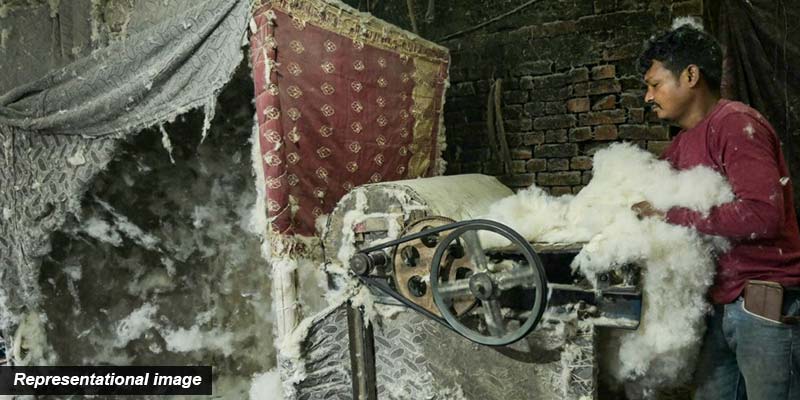
• The Cabinet Committee on Economic Affairs, chaired by Prime Minister Narendra Modi, approved Minimum Support Price (MSP) funding of Rs 1,718.56 crore to the Cotton Corporation of India (CCI) for the cotton season 2023-24.
• The MSP operations are undertaken to safeguard the interests of cotton farmers, particularly during periods when market prices fall below the MSP.
What is the reason for this reimbursement?
• During the 2023-24 cotton season, the area under cultivation was estimated at 114.47 lakh hectares, with production pegged at 325.22 lakh bales, accounting for nearly 25 per cent of global cotton output.
• The government of India fixes the MSP for seed cotton (kapas) based on the recommendations of the Commission for Agricultural Costs and Prices (CACP).
• As market prices of cotton fell below MSP during Cotton Season 2023-24 (October 1, 2023, to 30 September, 2024), the CCI had to undertake MSP operations to the extent of 32.84 lakh bales, benefiting about 7.25 lakh farmers and paying about Rs 11,712 crore directly into their bank accounts.
• The government has designated the CCI as the central nodal agency for undertaking MSP operations in cotton.
• CCI procures all Fair Average Quality cotton from farmers without any quantitative ceiling, whenever market prices fall below MSP levels.
• These interventions play a crucial role in stabilising cotton prices, preventing distress sales, and ensuring remunerative returns to farmers.
• By enhancing inclusivity in agricultural markets, MSP operations contribute significantly to the economic security of cotton-growing communities.
Cotton sector in India
• India is one of the largest producers, consumers and exporters of cotton in the world.
• Cotton is one of the most important cash crops and accounts for around 23 per cent of the total global fibre production.
• The consumption of cotton is approximately 326 lakh bales (170 kg each) per year.
• India occupies first position in the world in cotton acreage with 113.60 lakh hectares under cotton cultivation which is around 36 per cent of the world area of 316.20 lakh hectares.
• Approximately 62 per cent of India’s cotton is produced on rain-fed areas and 38 per cent on irrigated lands.
• Apart from being the provider of a basic necessity of life — clothing which is next only to food — cotton is also one of the largest contributor to India’s net foreign exchange by way of exports in the form of raw cotton, intermediate products such as yarn and fabrics to ultimate finished products in the form of garments, made ups and knitwear.
• Due to its economic importance in India, it is also termed as “white gold”.
• Cotton plays a major role in sustaining the livelihood of an estimated six million cotton farmers and 40-50 million people engaged in related activities such as cotton processing and trade.
• India grows all four known species of cultivated cotton. They are Gossypium arboreum, G.herbaceum, G.hirsutum and G.barbadense.
• To support the cotton industry, the government of India announces Minimum Support Price (MSP) for two basic staples groups — medium staple (24.5mm-25.5 mm) and long staple (29.5-30.5) cotton.
What is the role of Cotton Corporation of India?
• The Cotton Corporation of India (CCI) was set up in 1970 by the government as a public sector organisation in the field of cotton marketing.
• It is under the administrative control of the Ministry of Textiles.
• The Cotton Corporation of India (CCI) was set up in 1970 by the government as a public sector organisation in the field of cotton marketing.
• Ever-since its inception, the Corporation has been operating in competition with private cotton traders and other institutional buyers, its market share varying from 5 per cent to 8 per cent except in some years under MSP operations when it has gone up to 31 per cent.
• With the changing cotton scenario, the role and functions of the Corporation were reviewed and revised from time to time.
• As per the policy directives received from the ministry of textiles in 1985, the CCI is the sole agency of the government for undertaking Minimum Support Price (MSP) operations, whenever the prices of kapas (seed cotton) fall below the MSP level.
• CCI has established a robust procurement network across all 11 major cotton-growing States, with over 508 procurement centres operational in 152 districts, ensuring seamless and accessible procurement for farmers.
• Besides MSP operations, to fulfill the raw material requirement of the domestic textile industry, particularly during lean season, the Corporation undertakes commercial purchase operations at its own risk.
(The author is a trainer for Civil Services aspirants.)