
- India
- Mar 30
Varkala named in ‘20 Cities Towards Zero Waste’ initiative of UN
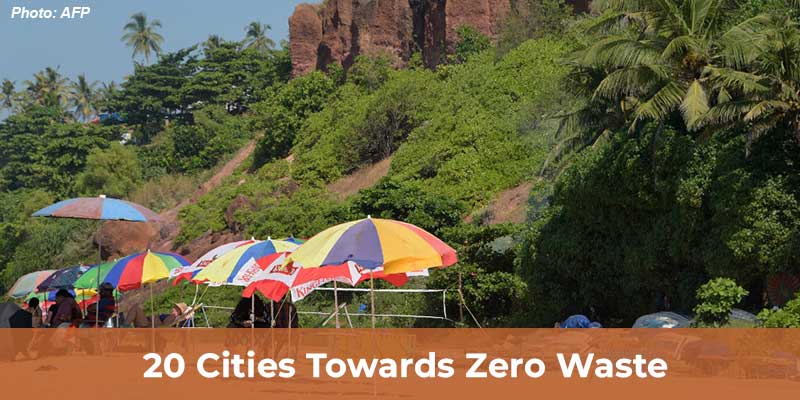
• Varkala in Kerala has been named in the inaugural 20 Cities Towards Zero Waste, an initiative led by the UN Secretary-General’s Advisory Board on Zero Waste, with support from UN-Habitat and the UN Environment Programme (UNEP).
• The initiative highlights cities demonstrating ambitious and innovative approaches to reducing waste, advancing circular economy solutions, and building more sustainable, resilient, and inclusive urban systems.
The selected cities are:
• Accra (Ghana)
• Bologna (Italy)
• Chefchaouen (Morocco)
• Dar es Salaam (Tanzania)
• Dehiwala City (Sri Lanka)
• Florianopolis (Brazil)
• Gaziantep (Turkey)
• George Town (Malaysia)
• Hangzhou City (China)
• Iloilo City (Philippines)
• Kisumu (Kenya)
• Kuala Lumpur (Malaysia)
• Lilongwe (Malawi)
• San Fernando (Philippines)
• San Francisco (United States)
• Sanya City (China)
• Suzhou City (China)
• Varkala (India)
• Yokohama (Japan)
• Zapopan (Mexico).
The initiative aims to:
• Recognise city leadership and innovation.
• Promote exchange of good practices and lessons learned.
• Inspire other cities to accelerate their transition toward zero waste.
• Support implementation of circular economy approaches at the local level.
• While still facing waste challenges, selected cities are implementing a wide range of solutions, including food waste prevention, organic waste management, reuse and refill systems, inclusive recycling models supporting informal workers, policies to reduce single-use products, and community engagement initiatives to drive behaviour change.
• The initiative contributes directly to the Sustainable Development Goals, particularly SDG 11 (Sustainable Cities and Communities), SDG 12 (Responsible Consumption and Production), and SDG 13 (Climate Action).
• The selected cities are recognised in connection with the International Day of Zero Waste and showcased on global platforms to share experiences and inspire further action.
• As urban populations grow, the leadership of these cities underscores the critical role of local governments in driving the transition toward a zero-waste and circular future.
International Day of Zero Waste
• Observed annually on 30 March, the International Day of Zero Waste highlights the importance of strengthening waste management globally and promoting sustainable consumption and production patterns.
• The Day is jointly facilitated by the United Nations Environment Programme (UNEP) and the United Nations Human Settlements Programme (UN-Habitat)
• This year’s International Day of Zero Waste focuses on food waste, a critical yet preventable driver of environmental harm.
• The world is wasting food at an alarming scale, undermining food security and slowing progress toward a zero-waste, circular future.
• Around 60 per cent of food waste happens at the household level.
• The rest comes mostly from food service and retail, the result of inefficient food systems — including production, distribution and consumption.
• Humanity generates more than 2.1 billion tonnes of municipal solid waste annually, making cities a vital part of global efforts to tackle the waste crisis and its impacts on climate, biodiversity, public health, and livelihoods.
• Food waste is undermining food security and compromising progress toward a zero-waste, circular future.
• Nearly 19 per cent of all food available to consumers is wasted every year, accelerating climate warming emissions and draining valuable resources such as land, water and energy.
• Reducing food waste is a top climate solution, and a smart choice to protect resources and save money.