
- India
- Apr 07
- Sreesha V.M
Kalpakkam’s 500 MWe PFBR attains criticality
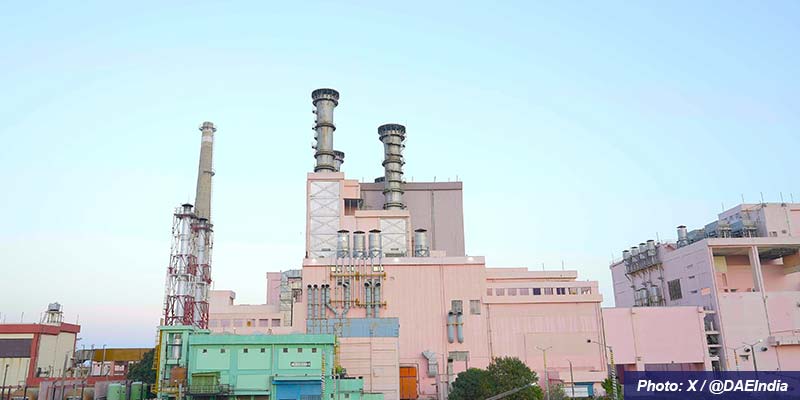
• In a landmark achievement for India’s nuclear energy programme, the 500 MWe Prototype Fast Breeder Reactor (PFBR) in Tamil Nadu’s Kalpakkam achieved first criticality.
• First criticality in a fast breeder reactor is the moment when the nuclear chain reaction becomes self-sustaining.
• This marks a historic step in providing long-term energy security and advancing indigenous nuclear technology capabilities.
• With this, India moves closer to realising the full potential of its three-stage nuclear power programme.
Three stages of India’s nuclear power programme
• India’s nuclear power programme has three stages with an objective to utilise modest uranium and large thorium reserves in the country to provide long term energy security.
• The programme is sequential and each stage has fuel cycle linkages in which spent fuel from one stage is reprocessed to obtain fuel for the next stage.
The three stages of the programme are:
i) First stage of Pressurised Heavy Water Reactors (PHWRs) using natural uranium fuel.
ii) Second stage of Fast Breeder Reactors (FBRs) using plutonium as fuel.
iii) Third stage of advanced reactors using U-233 as fuel in thorium-uranium cycle.
• The first stage yields plutonium, which forms the basis of development of the second stage, using plutonium along with depleted uranium/thorium in Fast Breeder Reactors (FBRs). This stage yields more plutonium.
• FBR, with closed fuel cycle as the energy resource, is capable of generating a large amount of U-233 (a fissile isotope) from the abundant available thorium within the country, to launch the third stage nuclear energy programme based on U-233 fuel cycle.
• The commercial deployment of thorium requires a significant capacity of FBRs and development of technologies for thorium utilization.
• Nuclear Power Corporation of India Limited (NPCIL) pursues the first stage of the programme comprising PHWRs, while Bharatiya Nabhikiya Vidyut Nigam Limited (BHAVINI) pursues the second stage of Nuclear Power Programme comprising FBRs.
• BHAVINI is a wholly owned enterprise of the government of India under the administrative control of the Department of Atomic Energy (DAE).
• BHAVINI was incorporated on October 22, 2003 as a Public Limited Company with the objective to construct, commission, operate and maintain FBRs.
• The mandate of BHAVINI is to construct and operate Prototype Fast Breeder Reactor (PFBR) at Kalpakkam, and future FBRs. The FBRs will generate power by recycling plutonium and depleted uranium recovered from the spent fuel of the PHWRs.
What is Prototype Fast Breeder Reactor (PFBR)?
• A Fast Breeder Reactor (FBR) is a nuclear reactor that uses fast neutrons to generate more nuclear fuels than they consume while generating power, dramatically enhancing the efficiency of the use of resources.
• Indira Gandhi Centre for Atomic Research (IGCAR) carried out a comprehensive R&D on sodium cooled Fast Breeder Reactor technology for the past few decades.
• A test reactor, called Fast Breeder Test Reactors (FBTR), was in operation from 1985 which provided valuable feedback.
• Based on this experience and also taking into account the international experience, design of a 500 MWe Prototype Fast Breeder Reactor (PFBR) was done.
• Bharatiya Nabhikiya Vidyut Nigam Ltd (BHAVINI) constructed the 500 MWe PFBR at Kalpakkam, Tamil Nadu.
• The plant is located 500 m south of the existing Madras Atomic Power Station.
• PFBR is liquid sodium cooled, pool type reactor using mixed oxide of uranium and plutonium as fuel.
• Unlike conventional thermal reactors, the PFBR uses Uranium-Plutonium Mixed Oxide (MOX) fuel.
• The core of PFBR is surrounded by a blanket of Uranium-238.
• Fast neutrons convert fertile Uranium-238 into fissile Plutonium-239, enabling the reactor to produce more fuel than it consumes.
• The reactor is designed to eventually use Thorium-232 in the blanket.
• Through transmutation, Thorium-232 will be converted into Uranium-233, which will fuel the third stage of India’s nuclear power programme.
• This unique capability significantly enhances the utilisation of nuclear fuel resources and enables the country to extract far greater energy from its limited uranium reserves while also preparing for large-scale use of thorium in the future.
• A unique feature of this sodium-cooled PFBR is that it can produce more fuel than it consumes, helping in achieving self-reliance in fuel supply for future fast reactors.
• PFBR is a stepping stone for the third stage of the nuclear programme, paving the way for the eventual full utilisation of India’s abundant thorium reserves.
• In terms of safety, PFBR is an advanced third-generation reactor with inherent passive safety features ensuring a prompt and safe shutdown of the plant in the event of an emergency.
• Since it uses the spent fuel from the first stage, PFBR also offers a great advantage in terms of a significant reduction in nuclear waste generated, thereby avoiding the need for large geological disposal facilities.
(The author is a trainer for Civil Services aspirants.)