
- India
- Apr 10
- Sreesha V.M
World Homoeopathy Day on April 10
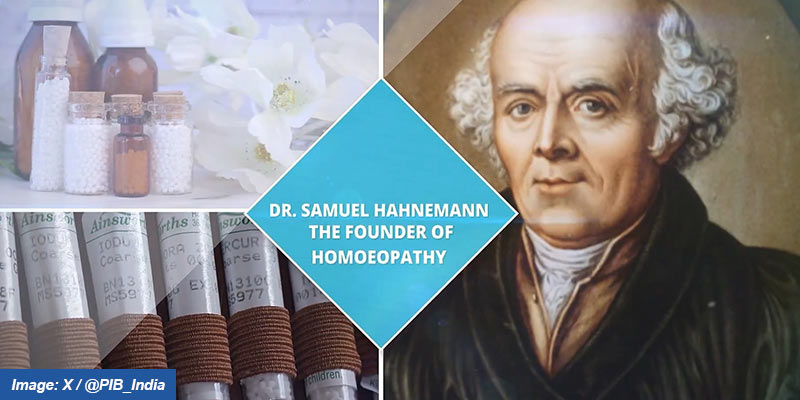
• World Homoeopathy Day is observed annually on April 10.
• It commemorates the birth anniversary of Dr. Samuel Hahnemann, the founder of homoeopathy.
• This year’s theme is “Homoeopathy for Sustainable Health”.
• Homoeopathy, derived from the Greek words Homois (similar) and Pathos (suffering), is a system of medicine that treats diseases using remedies which produce effects similar to the symptoms experienced by the patient.
• This approach was formalised in 1796 by Samuel Hahnemann, the founder of homoeopathy.
• Hahnemann (1755-1843) was a German physician.
• His seminal work, Organon of Medicine, continues to guide Homoeopathy practice worldwide.
• He established its foundational theories, first one being “like cures like”, which holds that substances capable of producing symptoms in a healthy individual can, in carefully prepared forms, treat similar symptoms in a sick individual.
• The second theory, known as the “law of minimum dose”, emphasises the use of highly diluted remedies to stimulate the body’s self-healing mechanisms while minimising side effects.
• Homoeopathic medicines are prepared from natural sources such as plants, minerals, and animal substances through dilution and succussion, and are administered in forms like tablets, globules, and liquids.
• A key feature is its individualised approach, where treatment is based on a patient’s overall physical and mental condition rather than just the disease.
Homeopathy in India
• Homoeopathy was introduced in India in the early 19th century, marking the beginning of its gradual expansion.
• Around 1810, John Martin Honigberger, a disciple of Samuel Hahnemann, began practising in India.
• His successful treatment of Maharaja Ranjit Singh in 1839 significantly boosted its acceptance among both elites and the general population.
• In the post-independence period, the government of India took steps to institutionalise homoeopathy.
• 1973: Establishment of the Central Council of Homoeopathy.
• 1978: Establishment of the Central Council for Research in Homoeopathy.
• These initiatives strengthened regulation, education, and research in the field.
• With nearly a quarter of a million registered homoeopathy practitioners, India accounts for one of the largest homoeopathic workforces in the world.
• Over the past century, the system has not only endured but has harmoniously integrated with the country’s rich traditions of natural and preventive healthcare.
• The establishment of the Ministry of AYUSH in 2014 marked a pivotal shift, bringing renewed policy focus to homoeopathy through structured interventions in research, standardisation, and global outreach.
• These efforts have helped transform homoeopathy from a traditionally practised therapy into a well-recognised, policy-driven component of India’s healthcare system.
• India is home to around 34 dedicated homoeopathic research centres, forming a strong foundation for systematic research.
• Leading these efforts, institutions such as the National Commission for Homoeopathy and Central Council for Research in Homoeopathy play key roles in advancing clinical research, drug standardisation, and interdisciplinary studies.
• The National Commission for Homoeopathy was established under the National Commission for Homoeopathy Act, 2020, which came into effect on July 5, 2021.
• With this, the Board of Governors and the Central Council of Homoeopathy, constituted under the Homoeopathy Central Council Act, 1973, were dissolved.
• Based in New Delhi, Central Council for Research in Homoeopathy (CCRH) promotes scientific and ethical research to strengthen clinical practice and support the global acceptance of homoeopathy.
• Scientific research in Homoeopathy is conducted through a network of 33 institutes/units all over India.
(The author is a trainer for Civil Services aspirants.)