
- India
- Apr 11
- Sreesha V.M
ISRO completes second integrated air drop test for Gaganyaan
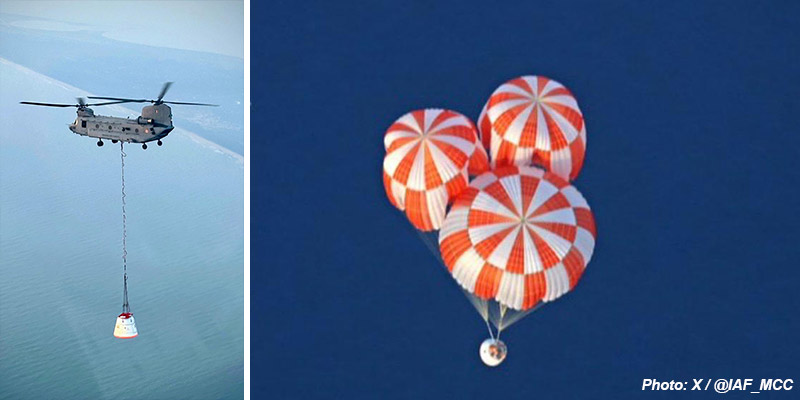
• Indian Space Research Organisation (ISRO) successfully conducted the second integrated air drop test (IADT-02) for the upcoming Gaganyaan mission at the space station in Andhra Pradesh’s Sriharikota.
• The IADT-02 follows the successful completion of the first IADT, which took place on August 24, 2025, at the Satish Dhawan Space Centre in Sriharikota.
• The system is essential to ensure a safe recovery of the crew module — the capsule in which astronauts sit during a human flight — during re-entry and landing.
How was the integrated air drop test conducted?
• Air drop tests recreate the last leg of a spacecraft’s return to Earth.
• An aircraft or helicopter drops the spacecraft from a height to test various systems under different scenarios.
• These are the deployment of the parachute system in case the mission is aborted mid-flight, system performance when one parachute fails to open and the spacecraft's orientation and safety during splashdown, etc.
• In the IADT-02 test, a simulated crew module, weighing about 5.7 tonnes, was lifted by an Indian Air Force Chinook helicopter to an altitude of about three kilometres and released over a designated drop zone in the sea, near the Sriharikota coast.
• Ten parachutes of four types were deployed in a precise sequence during the descent of the crew module, gradually reducing the velocity for safe touchdown.
• Subsequently, the simulated crew module was successfully recovered in coordination with the Indian Navy.
Gaganyaan Mission
• Prime Minister Narendra Modi announced the Gaganyaan mission in his Independence Day address in 2018.
• Gaganyaan project envisages demonstration of human spaceflight capability by launching a crew of three members to an orbit of 400 km for a three days mission and bring them back safely to Earth, by landing in Indian sea waters.
• For the first human spaceflight, four Indian Air Force pilots have been selected and are undergoing extensive training for the mission.
• A budget of Rs 9,023 crore is allocated towards achieving the objectives of the mission.
• ISRO developed indigenous technologies for the launch vehicle, habitable Crew Module, life support system, Crew Escape System, ground station network, crew training and recovery.
• These technologies are crucial to meet the objectives of Gaganyaan mission and to take up any further interplanetary missions.
• Gaganyaan will not be a one-off mission as the government has given approval for a sustained human spaceflight programme.
• The programme comprises three uncrewed missions and one crewed mission.
• The maiden Gaganyaan uncrewed mission is expected to be launched with a humanoid robot, Vyommitra.
• The first crewed mission is targeted in 2027-28.
(The author is a trainer for Civil Services aspirants.)