
- India
- Apr 13
- Sreesha V.M
Operation Meghdoot
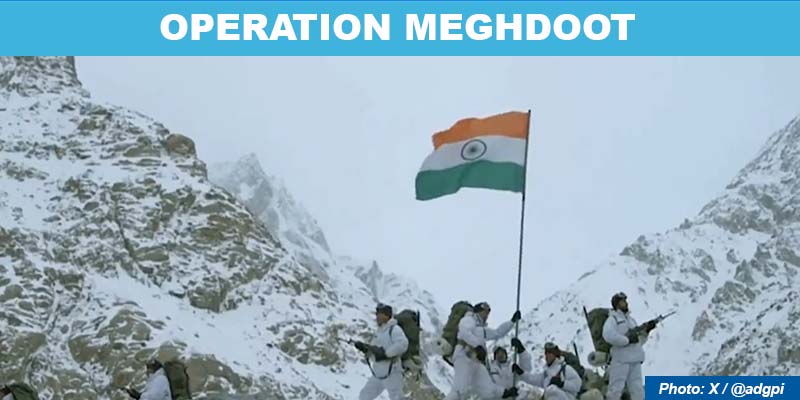
• India marked 42 years of the launch of Operation Meghdoot on April 13.
• Observed as Siachen Day, it marks the anniversary of the launch of Operation Meghdoot in 1984, when the Indian Army and Indian Air Force advanced to the Siachen Glacier to secure the heights dominating the Northern Ladakh region.
Why India launched Operation Meghdoot?
• Operation Meghdoot is an ongoing operation along north-western border region of India in the high altitude area of Siachen Glacier, ranging above 21,000 feet.
• Launched on April 13, 1984, this military operation was the first assault launched in the world’s highest battlefield.
• The troops of Indian Army and Indian Air Force (IAF) advanced with an aim to wrest control of the strategic heights on the Saltoro Ridge, overlooking the Nubra Valley.
• The operation involved the airlifting of Indian Army soldiers by the IAF and dropping them on the glacial peaks.
• Although the operation began in 1984, IAF helicopters were already operating in the Siachen Glacier since 1978, flying the Chetak helicopters which was the first IAF helicopter to land in the Glacier in October 1978.
• By 1984, Pakistan’s cartographic aggression in the uncharted territory of Ladakh, allowing foreign mountaineering expeditions in Siachen, was becoming a cause of concern.
• Having received intelligence inputs about an impending Pakistani military action in the area, India decided to thwart Pakistan’s efforts to legitimise its claim on Siachen.
• Playing an irreplaceable role in this effort, IAF’s tactical and strategic airlifters, An-12s, An-32s and IL-76s transported stores and troops and air-dropped supplies to high altitude airfields, from where Mi-17, Mi-8, Chetak and Cheetah helicopters ferried men and material to dizzying heights on the glacier, far above the limits set by the helicopter manufacturers.
• Soon, about 300-odd troops were positioned on the strategically important peaks and passes of the glacier.
• By the time the Pakistan army reacted by advancing its own troops, the Indian Army was occupying strategically crucial mountain peaks and passes, thereby gaining a tactical advantage.
• While the initial operations involved only the use of transport and helicopter aircraft transporting men and material, the IAF gradually expanded its role and presence in the region with the deployment of fighter aircraft as well.
• The military action resulted in Indian troops gaining control of the strategically located Siachen Glacier.
• It is considered as a feat unparalleled in the history of high altitude warfare where soldiers of Indian Army and Air Force operate under most adverse weather conditions with sub-zero temperatures.
• Siachen is the second-longest non-polar glacier in the world.
(The author is a trainer for Civil Services aspirants.)