
- India
- Apr 28
- Sreesha V.M
India, New Zealand ink Free Trade Agreement
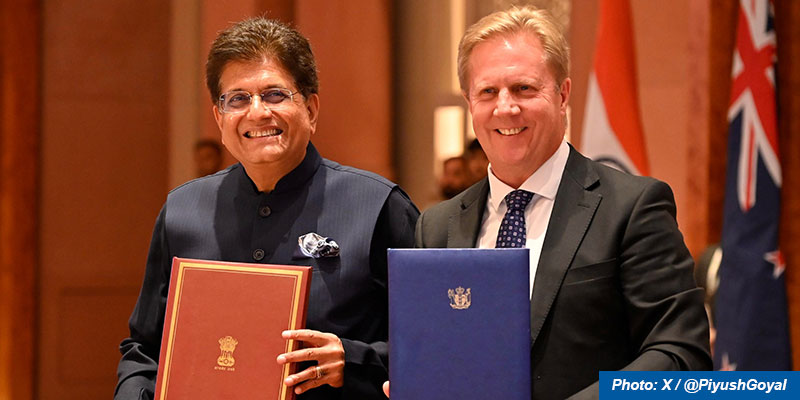
• India and New Zealand signed a Free Trade Agreement (FTA) in New Delhi on April 27.
• The agreement was signed by Union Minister of Commerce and Industry Piyush Goyal and New Zealand’s Minister for Trade and Investment Todd McClay.
• The FTA provides duty-free access for 100 per cent of India’s exports to New Zealand.
• The signing of the India-New Zealand FTA marks a new and significant chapter in the bilateral relationship.
India’s fastest-concluded FTA
• The negotiations were formally launched on March 16, 2025 during the meeting between Commerce and Industry Minister Piyush Goyal and New Zealand’s Minister for Trade and Investment Todd McClay.
• The agreement was concluded in December 2025 by holding continuous and intense discussions spread over five formal negotiation rounds.
• The agreement stands out as one of India’s fastest-concluded FTAs.
• The pact is expected to be implemented by the end of this year as it requires New Zealand Parliament's approval.
• New Zealand is India’s second-largest trading partner in the Oceania region, with bilateral trade valued at around $1.3 billion.
• With the coming into force of the India-New Zealand FTA, bilateral trade is expected to witness further growth, supported by enhanced market access, greater trade facilitation, and deeper economic engagement between the two countries.
• It is expected to help double bilateral trade in goods and services to $5 billion in five years.
Highlights of India-New Zealand FTA:
• The FTA provides duty-free access for 100 per cent of India’s exports to New Zealand, covering all tariff lines, and is expected to significantly boost MSMEs and employment by enhancing competitiveness in labour-intensive sectors such as textiles, apparel, leather, footwear, gems and jewellery, engineering goods, and processed foods.
• India secures duty-free inputs for its manufacturing sector, including wooden logs, coking coal, and waste and scraps of metals, lowering production costs and enhancing the global competitiveness of Indian industry.
• India has offered tariff liberalisation on 70.03 per cent of tariff lines covering 95 per cent of bilateral trade value, while keeping 29.97 per cent of tariff lines in exclusion to protect India’s sensitive sectors.
• The products that are kept in exclusion are mainly — dairy (milk, cream, whey, yoghurt, cheese, etc); animal products (other than sheep meat); agricultural products (onions, chana, peas, corn, almonds, etc), sugar, artificial honey; animal, vegetable or microbial fats and oils; arms and ammunition; gems and jewellery, copper and articles thereof (cathodes, cartridges, rods, bars, coils, etc); aluminium and articles thereof (ingots, billets, wire bars) among others.
• The FTA includes a commitment of facilitating $20 billion in Foreign Direct Investment (FDI) into India, strengthening long-term economic cooperation and supporting India's growth and development objectives under the Make in India vision.
• The partnership includes the establishment of Centres of Excellence, improved planting material, capacity building for growers, collaborative research, and technical support for orchard management, post-harvest practices, supply chain performance and food safety.
• Market access commitments to India in New Zealand in about 118 services sectors that include key sectors of interest to India including computer-related services, professional services, audio-visual services, other business services, telecommunication services, construction services, distribution services, education services, environmental services, financial services, tourism and travel-related services, etc.
• Most-Favoured Nation (MFN) commitment in about 139 sub-sectors which include major interest areas of India.
• MFN commitment means that if New Zealand gives better treatment to any other country in those sectors later, it can extend the same treatment to India as well.
• The FTA establishes a new Temporary Employment Entry (TEE) visa pathway with a quota of 5,000 visas for skilled Indians for stay up to three years. The sectors of interest to India include occupations like AYUSH practitioners, yoga instructors, Indian chefs, and music teachers. The other sectors of interest also include IT, engineering, healthcare, education, and construction.
• New Zealand has created a dedicated pathway on student mobility and post study work visas with India. The agreement removes numerical caps on Indian students, guarantees a minimum of 20 hours per week work during study, and provides extended post-study work opportunities-up to three years for STEM bachelor’s and master’s graduates, and up to four years for doctorate holders-creating clear pathways for skills development and global careers.
• The agreement further enhances youth mobility through multiple-entry Working Holiday Visas for 1,000 young Indians annually, valid for 12 months, promoting global exposure, skills acquisition, and people-to-people linkages.
• The FTA incorporates a comprehensive set of trade facilitation measures to reduce transaction costs, enhance transparency, and modernise border procedures. Standard cargo clearance is committed to within 48 hours, with express shipments and perishable goods cleared within 24 hours.
• New Zealand has a dedicated health and traditional medicine services access. This provision promotes the global recognition of India’s AYUSH systems, supports medical value travel, encourages collaboration in wellness services, and reinforces India’s position as a global hub for health, wellness, and traditional medicine services.
(The author is a trainer for Civil Services aspirants.)