
- India
- Apr 29
- Sreesha V.M
Rajnath Singh attends SCO Defence Ministers’ Meeting in Kyrgyzstan
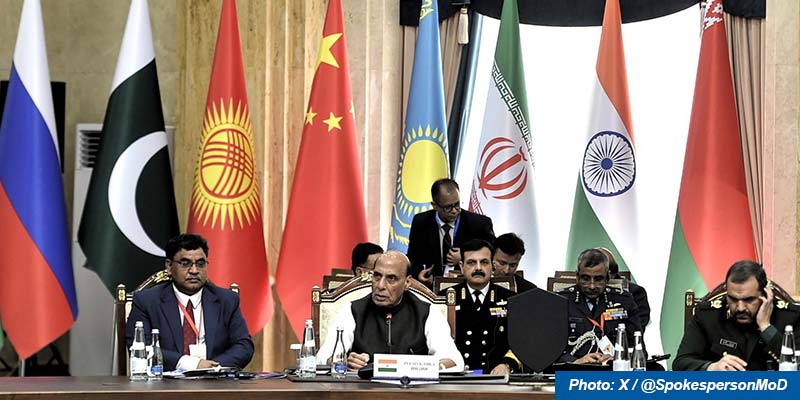
• The Meeting of Defence Ministers of the Shanghai Cooperation Organisation (SCO) member states was held in Bishkek under the chairmanship of Kyrgyzstan.
• The meeting was attended by the heads of defence agencies of SCO member states, the SCO Secretary-General, and the Director of the Executive Committee of the SCO Regional Anti-Terrorist Structure.
• The current Secretary-General of the SCO is Nurlan Yermekbayev from Kazakhstan. He assumed office in January 2025 for a three-year term.
• This year’s SCO meeting took place in the backdrop of geopolitical turmoil being witnessed due to the situation in West Asia.
• Defence Miniaster Rajnath Singh led a high-level Indian delegation to the meeting.
• During the meeting the parties conducted a thorough exchange of views on pressing issues of regional and international security noting persistent challenges and threats including international terrorism, extremism, transnational crime as well as new risks in the field of information and cybersecurity.
• The ministers emphasized the importance of further strengthening trust and mutual understanding among the armed forces of the member states, enhancing practical cooperation including the conduct of joint exercises, exchange of experience and the development of military cooperation mechanisms within the SCO.
• The SCO members emphasised the symbolic significance of 2026, which marks the 25th anniversary of the founding of the organisation and how its role is becoming more important than ever due to growing unpredictability and uncertainty.
Rajnath Singh calls for action against terrorism
• During his address at the meeting, Rajnath Singh said ‘Operation Sindoor’ demonstrated India’s firm resolve that terror epicentres are no longer immune to justifiable punishment.
• He called on the influential grouping to not lose sight of “State-sponsored” cross-border terrorism and that there should not be any place for any double standards in combating the menace.
• The Defence Minister emphasised that the SCO should not hesitate in seeking appropriate action against those who abet, shelter and provide safe havens to terrorists.
• He further stated that, in view of the present global uncertainties, SCO holds a pivotal role as today’s world view appears fractured and countries are becoming increasingly inward-looking.
• He held bilateral meetings with his Kyrgyz, Kazakh and Belarusian counterparts on the sidelines of the meeting in Bishkek.
• He also met his Chinese counterpart Admiral Dong Jun in Bishkek to discuss maintaining peace and tranquillity along the Line of Actual Control (LAC) and broader regional security concerns including the West Asia crisis.
What is the SCO?
• The Shanghai Cooperation Organisation (SCO) is an intergovernmental organisation founded in Shanghai on June 15, 2001. It was founded by the presidents of China, Kazakhstan, Kyrgyzstan, Russia, Tajikistan and Uzbekistan.
• These countries, except for Uzbekistan, had been members of the Shanghai Five group, formed on April 26, 1996 with the signing of the Treaty on Deepening Military Trust in Border Regions.
• The SCO Charter was signed during the St Petersburg heads of state meeting in June 2002 and entered into force on September 19, 2003. This is the fundamental statutory document which outlines the organisation’s goals and principles, as well as its structure and core activities.
• The Heads of State Council (HSC) is the supreme decision-making body in the SCO. It meets once a year and adopts decisions and guidelines on all important matters of the organisation.
• The Council of Heads of Government (Prime Ministers) meets once a year to discuss the strategy of multilateral cooperation and priority areas within the Organisation, determine fundamental and topical issues in economic and other spheres, and approve the budget of the SCO.
• There are also mechanisms for meetings on foreign affairs, national defence, security, economy and trade, culture, health, education, transport, emergency prevention and relief, science and technology, agriculture, judiciary, tourism, industry, energy, poverty alleviation, sports, etc.
• The SCO is an influential economic and security bloc and has emerged as one of the largest transregional international organisations.
Members of SCO
• The SCO currently comprises ten member states (China, India, Iran, Kazakhstan, Kyrgyzstan, Russia, Pakistan, Tajikistan, Uzbekistan and Belarus).
• Other observer states interested in acceding to full membership are Afghanistan and Mongolia.
• There are 15 dialogue partners — Azerbaijan, Armenia, Bahrain, Egypt, Cambodia, Qatar, Kuwait, Lao People's Democratic Republic, Maldives, Myanmar, Nepal, the United Arab Emirates, Saudi Arabia, Turkey and Sri Lanka.
• India, Iran and Pakistan were admitted as observers at the 2005 summit. On June 9, 2017, at the historic summit in Astana, India and Pakistan officially joined the SCO as full-fledged members.
• In July 2023, Iran became a permanent member of the SCO at an India-hosted virtual summit of the grouping.
• The SCO has two permanent bodies — the SCO Secretariat in Beijing and Executive Committee of the Regional Anti-Terrorist Structure (RATS) in Tashkent.
• The chairmanship of the SCO is by rotation for a year by the Member States.
The SCO’s main goals are:
i) Strengthening mutual trust and neighbourliness among the Member States.
ii) Promoting their effective cooperation in politics, trade, economy, research, technology, culture, education, energy, transport, tourism, environmental protection and other areas.
iii) Making joint efforts to maintain and ensure peace, security and stability in the region.
iv) Moving towards the establishment of a democratic, fair and rational new international political and economic order.
India and the SCO
• India was made an observer at the July 2005 Astana Summit and has generally participated in the ministerial-level meetings of the grouping, which focus mainly on security and economic cooperation in the Eurasian region.
• India and Pakistan became its permanent members in 2017.
• India has shown keen interest in deepening its security-related cooperation with the SCO and its Regional Anti-Terrorism Structure (RATS), which specifically deals with issues relating to security and defence.
(The author is a trainer for Civil Services aspirants.)