
- India
- Apr 30
- Sreesha V.M
Women’s participation in decision-making in India
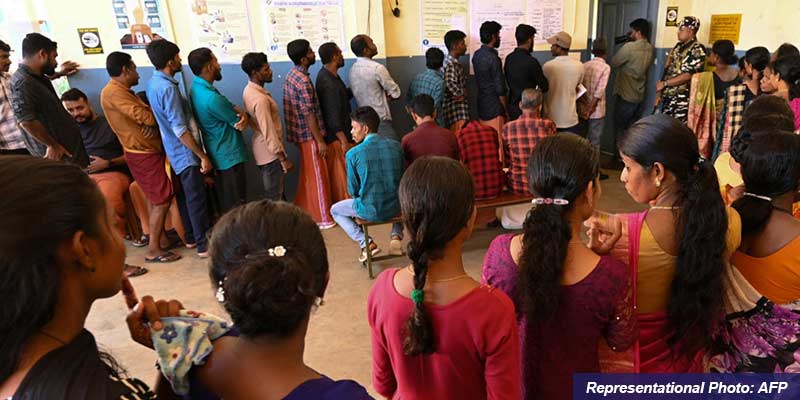
• The Ministry of Statistics and Programme Implementation (MoSPI) released the 27th edition of its publication titled ‘Women and Men in India 2025: Selected Indicators and Data’ on April 29.
• The publication presents a comprehensive overview of the status of women and men in India through a compilation of selected indicators across key domains, including population, education, health, economic participation, decision-making, violence against women, and other gender-related issues, drawing upon inputs from various Ministries, Departments and organisations.
Some of the highlights of the publication are:
• The sex ratio at birth has increased at the all-India level, indicating improved survival of females reaching from 904 in 2017-19 to 917 in 2021-23.
• As of 2023, the highest sex ratio is in northeastern states of Arunachal Pradesh, where women outnumber men with a sex ratio of 1,085, followed by Nagaland (1,007), followed by Goa (973). The worst performing are Jharkhand (899) and Bihar (900).
• Infant mortality rate for both female and male infants has recorded a pronounced and sustained decline between 2008 and 2023.
• Gender parity has been achieved across all levels of school education from primary to higher secondary level.
• Gross Enrolment Ratio at Higher Education has improved from 28.5 to 30.2 for females and 28.3 to 28.9 for males between 2021-22 and 2022-23.
Participation in decision-making
• Decision-making is fundamental to the exercise of agency and the ability of individuals to shape social, economic, and political outcomes.
• Women, who are equally affected by contemporary challenges in development, peace, and security, must therefore be engaged in decision-making processes across all spheres and at all levels.
• Yet, despite this imperative, women remain significantly underrepresented in key decision-making institutions, particularly within legislative, judicial, and executive domains.
• Moreover, available data on women’s participation in public decision-making often fails to fully capture women’s autonomy and agency in private and community spaces, where entrenched social norms and discriminatory practices continue to constrain their ability to make choices freely.
• Women’s contribution to household decision-making is also captured as a critical indicator of their autonomy and agency in everyday life in the private sphere.
• As of 2025, women constitute 13.65 per cent of Members of Parliament, and 9.86 per cent hold ministerial portfolios.
• Women account for 49.75 per cent of elected Panchayat representatives where 16 states report more than 50 per cent women’s representation in Panchayati Raj Institutions (PRIs).
• Representation of women in PRIs is the highest in Assam (60.1 per cent), followed by Dadar & Nagar Haveli and Daman & Diu (56.93 per cent), and Chhattisgarh (56.5 per cent).
• Of the 1,122 approved judicial positions, only 118 are held by women, accounting for just 14.30 per cent of the judiciary. In the Supreme Court, women constitute merely 3.03 per cent of the permanent strength of 33 judges.
• The defence sector, including the army and navy, has seen a rise in the number of women serving from 2020 and 2025.
• Women account for 8.31 per cent of the total defence forces with the highest share in the Defence Research and Development Organisation (15.42 per cent), followed by Indian Air Force (12.92 per cent).
• There has been a 73.80 per cent increase in men engaged in managerial positions between 2017 and 2025, whereas there has been a 102.54 per cent increase in Women engaged in managerial positions during the same time period.
• Women’s participation in household decision-making has seen a marked improvement. At least 16 out of 28 states and six out of eight Union Territories report more than 90 per cent of women participating in household decision-making as of 2019-21.
(The author is a trainer for Civil Services aspirants.)