
- India
- May 02
- Sreesha V.M
Govt launches Cell Broadcast System
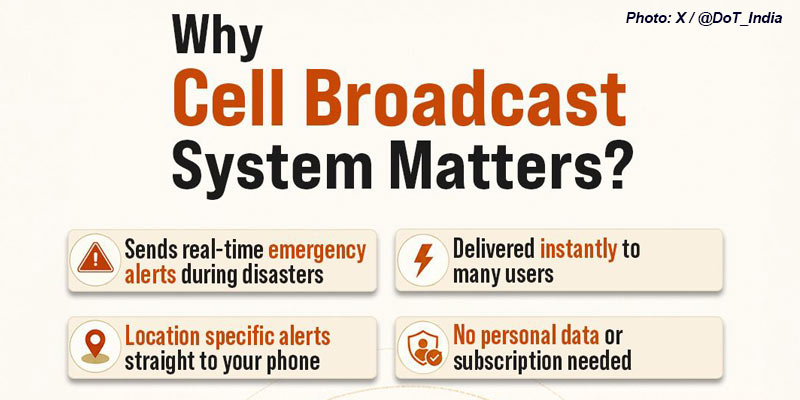
• Union Minister of Communications Jyotiraditya Scindia launched the Cell Broadcast System (CBS) on May 2.
• As part of the launch, a nationwide test of the system was successfully conducted, during which emergency alert messages were broadcasted to mobile phones across the country, accompanied by a distinctive alert tone.
• This demonstration marks a major milestone in ensuring timely dissemination of alerts during disasters and emergency situations.
• This initiative marks a significant step towards strengthening India’s emergency communication systems and enhancing public safety infrastructure.
What is Cell Broadcast Solution (CBS)?
• Cell Broadcast Solution (CBS) is a telecom-enabled public warning system that enables authorities to broadcast simultaneous, geo-targeted alerts to mobile devices within a defined area.
• It is an indigenous technology developed by the Centre for Development of Telematics (C-DOT) under the Department of Telecommunications (DoT), in collaboration with the National Disaster Management Authority (NDMA) and the Ministry of Home Affairs (MHA).
• Integrated with the CAP-based SACHET platform, it allows rapid and standardised dissemination of alerts.
• NDMA has successfully operationalised the Integrated Alert System (SACHET), developed by the Centre for Development of Telematics (C-DOT), the premier R&D centre of the Department of Telecommunications.
• To further strengthen alert dissemination in time-critical situations, such as tsunamis, earthquakes, lightning strikes and man-made emergencies like gas leaks or chemical hazards, Cell Broadcast (CB) technology has been introduced alongside SMS.
• C-DOT has been entrusted with the indigenous development and implementation of this Cell Broadcast-based public emergency alert system.
• CBS offers precise geo-targeting capabilities, enabling alerts to be disseminated at the level of individual cell towers or clusters, while also allowing scalability to cover larger geographic areas. Messages are delivered in near real-time, reaching users within seconds without any queuing delays.
• It overcomes the limitations of traditional SMS-based systems, ensuring that critical information can be disseminated quickly and efficiently to large populations within targeted areas.
• Designed for high reliability, the system remains unaffected by network congestion, ensuring uninterrupted communication during critical situations. • It provides universal reach by covering all mobile users within the targeted area, including those who are roaming, and these alerts cannot be disabled by users. Additionally, alerts are delivered as priority notifications, appearing as pop-up messages accompanied by distinct loud tones, with message text read aloud on supported mobile handsets.
• The system enables near real-time, multilingual alerts that provide critical time for protective action in disasters such as flash floods and gas leaks. Supported across 2G to 5G networks, it ensures wide reach in both urban and rural areas, including last-mile and roaming populations. By enabling direct, official communication, it strengthens disaster management, drives quick response, reduces panic, and enhances public trust and compliance.
(The author is a trainer for Civil Services aspirants.)