
- India
- May 05
BJP scripts history in West Bengal elections
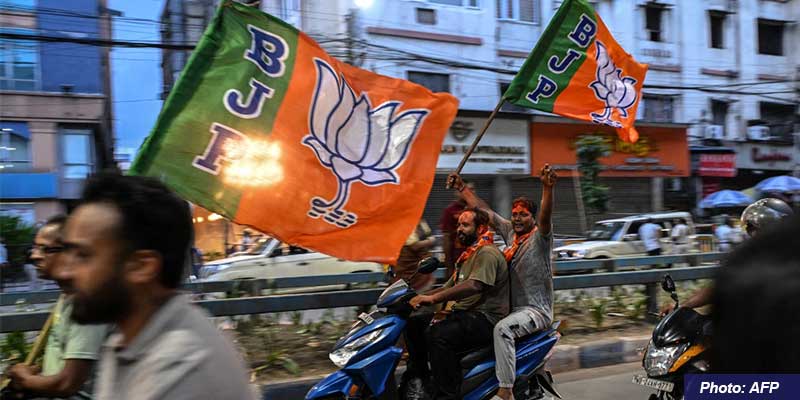
• The BJP scripted history by securing more than a two-thirds majority in the West Bengal Assembly polls on May 4.
• The saffron party won 202 seats, comfortably crossing the majority of 148 seats in the 294-seat Assembly and ending the Trinamool Congress’s 15-year rule in the state.
• West Bengal voted for its eighteenth legislative Assembly in two phases, on April 23 and 29.
• Chief Minister and TMC supremo Mamata Banerjee was defeated in Bhabanipur seat by BJP’s Suvendu Adhikari.
• Once the poster boy of the TMC and a key face in Banerjee’s anti-land acquisition movement in Nandigram, Adhikari switched to the BJP in 2019 — a move that dramatically altered West Bengal politics and propelled him to prominence.
• For the first time since 1972, West Bengal appears set to be governed by a party that is also in power at the Centre.
• From a marginal vote share of around four per cent in 2011, the BJP surged to nearly 40 per cent in 2019 and then secured 77 seats in the 2021 Assembly elections, displacing the Left and Congress as the principal challenger to the TMC.
• The vote share data underscored the depth of the shift. The BJP’s vote share climbed to around 45 per cent from 38 per cent in 2021, while the TMC’s dropped to nearly 40.94 per cent from 48 per cent.
• A key point lay in the 177 constituencies where voter deletions had exceeded past victory margins.
• In these seats, the BJP not only retained its earlier gains but also made significant inroads into TMC-held territories.
• The scale of the setback was also reflected in the fortunes of senior TMC leaders.
• At least 20 ministers were defeated, including Bratya Basu, Manas Ranjan Bhunia, Shashi Panja and Chandrima Bhattacharya.
• After 15 years in power, the TMC faces the difficult transition from a dominant ruling force to an opposition formation.