
- India
- May 08
- Sreesha V.M
NITI Aayog launches Central Prabhari Officer (CPO) portal
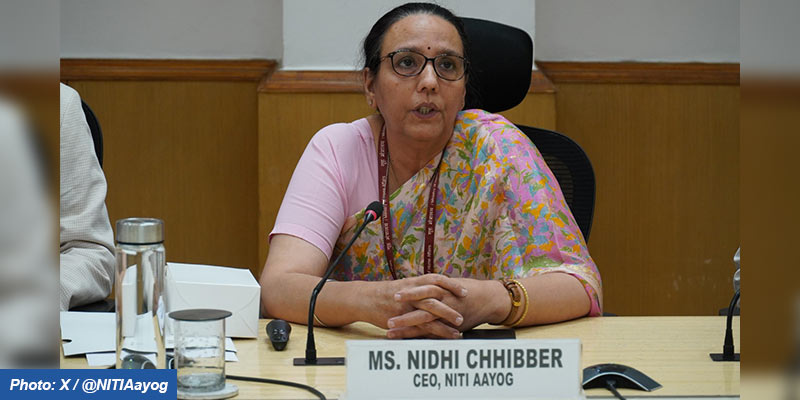
• NITI Aayog launched the Central Prabhari Officer (CPO) Portal on May 5.
• It is aimed at strengthening real-time governance, improving coordination among stakeholders and accelerating last-mile delivery under the Aspirational Districts and Blocks Programme (ADP/ABP).
• The portal was formally launched by Nidhi Chhibber, CEO, NITI Aayog.
How does it work?
• The platform enables real-time submission and tracking of field observations, ensuring that insights from the ground directly inform policy actions and administrative interventions.
• Through this portal, Central Prabhari Officers would submit their observations and recommendations from the field in real time via mobile.
• Once submitted, the data goes live after which the districts can view the suggestions provided by their CPO, take appropriate action and accordingly submit their responses.
• In this process, the State Planning Secretaries would gain a comprehensive view, coordinating across departments to implement suggestions and record their feedback.
• Simultaneously, officers at NITI Aayog and line ministries and departments would be able to monitor these inputs.
• The CPO portal serves as a unified digital interface that bridges the gap between field observations and administrative action.
• By enabling instant visibility, structured monitoring, and accountability, the platform is expected to significantly improve implementation efficiency and responsiveness in Aspirational Districts and Blocks.
What is Aspirational Districts Programme?
• The government of India launched the ‘Transformation of Aspirational Districts’ (Aspirational Districts Programme) initiative in January 2018 wherein the focus is to raise living standards of its citizens and ensure inclusive growth of all in the burgeoning economy.
• The districts are prodded and encouraged first to catch up with the best district of their state, and subsequently aspire to become one of the best in the country, by competing with and learning from others in the spirit of competitive and cooperative federalism.
• As many as 112 Aspirational Districts across 28 states/UTs were identified by NITI Aayog based upon composite indicators which have an impact on Human Development Index (HDI).
They are:
i) Health and Nutrition
ii) Education
iii) Agriculture and Water Resources
iv) Financial Inclusion and Skill Development
v) Basic Infrastructure.
The three core principles of the programme are:
i) Convergence (of central & state schemes)
ii) Collaboration (of central, state level nodal officers & district collectors)
iii) Competition among districts through monthly delta ranking.
• With states as the main drivers, this programme focuses on the strength of each district, identifying low-hanging fruits for immediate improvement and measuring progress by ranking districts every month.
• The ranking is based on the incremental progress made across 49 Key Performance Indicators (KPI) under five broad socio-economic themes mentioned above.
• NITI Aayog has developed a broad template for the formulation of district plans. Since different districts have different opportunities and challenges, they have been advised to customise the template.
• A primer comprising steps to be taken to improve each of the indicators, compiled from the inputs received from respective ministries, has also been developed with the help of central ministries and states and shared with district administration.
Aspirational Blocks Programme
• Prime Minister Narendra Modi launched the Aspirational Blocks Programme (ABP) on January 7, 2023.
• The programme focuses on improving governance to enhance the quality of life of citizens and service delivery in the remotest and less developed blocks of India. This is done through converging existing schemes, defining outcomes, and monitoring them constantly to bridge gaps.
• The programme covers 513 blocks. It focuses on improving governance to enhance the quality of life of citizens in the most difficult and underdeveloped blocks of the country by converging existing schemes, defining outcomes, and monitoring them on a constant basis.
The Aspirational Blocks strategy hinges upon three broad contours:
i) Convergence (of central & state schemes)
ii) Collaboration (between NITI Aayog, central ministries, state departments, district & block administration)
iii) Competition among blocks driven by a spirit of mass movement.
• In consultation with various stakeholders, 40 key performance indicators (KPIs) were chosen to measure progress of the blocks which have been grouped into five themes.
They are:
i) Health and Nutrition
ii) Education
iii) Agriculture and allied services
iv) Basic Infrastructure
v) Social Development.
• This programme identifies Block Officials as Leaders of Change, equipped with the right skills and competencies, to steer and drive transformation in their blocks.
• These grassroot administrators will work under the encouragement, guidance and support of their respective state and district administrations to achieve their defined strategies and output.
(The author is a trainer for Civil Services aspirants.)